
Day 4
From my 30 days of grief prompts.
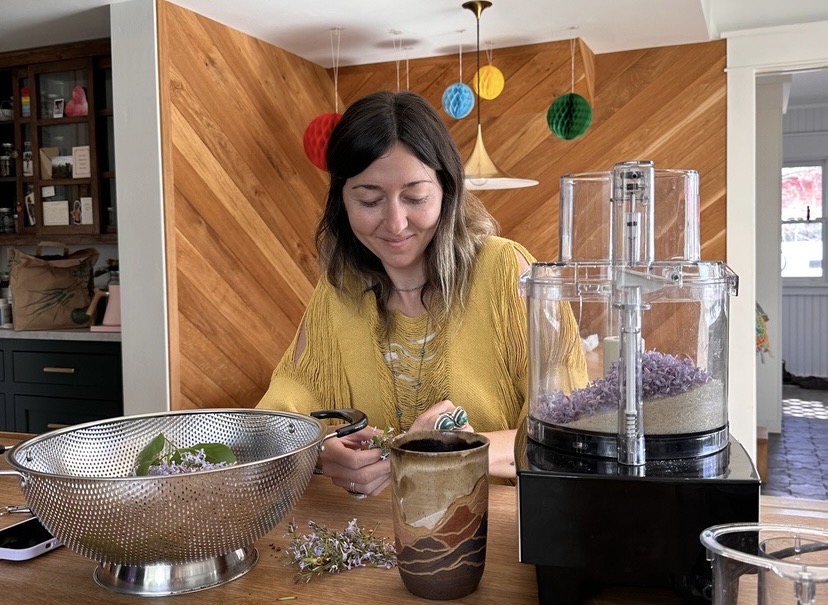
Emery making lilac sugar.
I can smell her. It’s more than the scent she rolled onto her wrist that I’ve now adapted, or the rosewater she had in every room that she’d spray on her face regularly, which I’ve also adapted. It’s putting my face into a jar of herbs for tea that Emery blended for me to help me recover from fatigue, COVID-19, depression, or digestive issues. She smelled like the earth, like sunshine, like roses in bloom, and the sweaty heads of children who had been playing tag in the yard. She led with wafts of cinnamon, lavender, and her favorite, lilac. They were easy smells to like. Emery also liked the smell of a musty cabin, something that I could never understand. She said it smelled like history, like stories that were hiding in the wall. I tried to appreciate her view, but never could. I thought musty cabins smelled forgotten. Emery smelled like the essence of life, and it’s a thread of her that still exists in her absence.
Emery and I shared our love of all things lilac — their scent, their beauty in a vase or on a bush, treasured even more by their fleeting appearance. My neighbor has a large lilac bush that is on the property line between our houses. He once told me that because the bush extends into my yard, I should feel free to cut blossoms. I told him the same about my peach tree, whose branches extend into his yard. We shared. Cutting the blossoms and putting them into a glass pitcher of water, never a vase (for reasons of nostalgia), evoked memories of my childhood. Mom would fill a large white pitcher with the blossoms from the large lilac bush outside our back porch every spring. Emery would use the lilac blossoms from my shared bush or from one in her yard to make lilac sugar for baking, something I had never seen or heard of lilac sugar until I saw her use some for a Mother’s Day cake. I liked that she had found a way to extend the blossoms that never lasted long enough. There were random years that my neighbor’s shared bush didn’t bloom, and maybe that is typical for a lilac. I don’t know, but the spring after Emery died was one of those years.
During Emery’s period of discovery in her freshman year of college, she underwent near-weekly transformations as she tried to understand who she was in this new phase of independence. It began with dyeing her hair red, one of her more difficult transformations that involved a lot of washing and empathy on my part. As her Mom, it was hard for me to watch some of the transformations, knowing what the end result would likely be, but having gone down a similar path myself, I understood my role. Stand back, reserve comment, and be at the ready to help her undo what she had done if necessary. She wanted to find a scent that people would associate with her. Applying a personal scent was a lot easier than getting red dye out of her hair. She found that scent in a shop near campus — I’m guessing next to the incense sticks and patchouli oil.
She told me that shortly after she began wearing it, she was approached by a man in the grocery store checkout line. He told her he didn’t know what she had on, but she should continue wearing it because it was amazing; her fragrance choice was confirmed, and she now had her scent. She bought more of the small bottles and gave a few to me as she thought I, too, needed to be singled out by a handsome man while I waited to pay for my groceries. The bottles were the size of a tube of ChapStick, with Chinese characters on the front, and likely had a buy-two-get-the-third-free pricing. The scent was OK, but not good enough to complement a perfect stranger. I’m guessing the man who complimented her may have been more interested in her than the scent she was wearing.wearing. I used the oil once or twice, then threw it away. Emery eventually did the same. Unlike Emery, though, I was not approached by a handsome stranger bearing compliments in the grocery store.
Years later, after I moved to Boulder, Emery bought me another scented oil for my birthday from a local boutique near my house. I loved it and quickly went through the small bottle. It was ten times the price of the oil from several years ago, and the label was in English, not Chinese. Emery had graduated to the more refined, more expensive scents, and no doubt, the strangers still complimented.
When I was helping two of her friends go through her toiletry items in her bathroom after she died, I discovered another of her scents, and I have rolled it onto my wrists every day since because it smells like her. It was what I smelled when I hugged her. It was what her clothing smelled like when we went through her closet. It was the scent I searched for in her clothing as I instinctively held her clothing to my face, item by item. It was more than a curiosity. It was tangible, immediate proof of her existence that remained even when she no longer did.
A few months after Emery died, when I was staying with Thomas and his family in Portland, Brooke hugged me, and as she pulled away, she told me she wanted to share something about Emery that she hoped wouldn’t offend me. I told her to tell me everything, as I needed to hear every story, every memory, every everything about Emery. She told me that my lines of connection with Emery went deeper than I might have realized because Emery and I smelled the same. It wasn’t from the perfume or anything we put on our bodies or hair; it was our essence, and we smelled the same. She told me that Emery had borrowed one of her shirts while kayaking in Florida a few months before she died. The next time she wore the shirt, she pulled it close to take in its scent and smelled Emery. When she hugged me, she smelled the same scent. She told me she smells Emery in the guest room after I leave.
Scent is a primal connection that begins in the womb and continues as babies imprint on their mothers from birth. I wondered, had I noticed that same scent when I hugged Emery? Or was it too embedded in who we were for either of us to notice?
I thought about the story Miles told me about Muna and the braid of Emery’s hair that had been cut and saved after she died. He told me that every morning, she would hold the braid up to her nose and take in its scent. It felt primal to me, like she was trying to find her Mama in the braid as she held it to her face. She was looking for her Mama in the same way I search for Emery in my memories, my photos, the signs she sends me, and in her scent.
The same thread of scent that began in utero and was passed down from me to Emery continued from Emery to Muna. Out of it came the strong maternal drive to protect and bond, which has endured even after death. Connecting to that thread now is putting my face into a jar of herbs and inhaling, spraying my face with rose water, and taking in the scent and the nostalgia of a pitcher of lilacs in May. Like Muna, I’m trying to find her any way I can.