Shared Grief

I couldn’t look at the faces in the Zoom boxes on my computer when it was my turn to share my story. Instead, I focused on a photo of Emery and me on a hike. I also couldn’t get through my story without tears, but I didn’t try. The tears came slowly and crescendoed into sobs as I shared my grief story with the group. I was not alone.

I’ve opened my computer many times since 2020 to join a Zoom class, usually for a writing workshop, but this time was different. This time, my screen wasn’t filled with boxes of writers, with pens poised to respond to writing prompts, ready (or not ready) to share their words. Instead, there were eight boxes with faces I recognized. Not because I knew them, because I didn’t, but because of the emotions their faces held. We are here because of our grief, the thread that connects us.

The eyes in the squares on my computer looked tired. Like mine. Pretenses and hiding behind masks have been replaced with raw emotions and vulnerability. It was my first day of a grief group on Zoom, facilitated by a therapist I’ve been seeing in Boulder. I was nervous, and while waiting to begin, I began to question my decision to sign up for this group, wondering if it was too late to withdraw, while gathering the words I would tell the therapist as to why I wouldn’t be joining them. This is a predictable response for me when something scares me. Although I’ve done this countless times, writing the script in my head as to why I have to quit, I rarely follow through with my quitting plans. This group was no different. Maybe the process of going through the steps of almost quitting is where I find my courage to stay. It’s just one of my steps.

I had pen and paper next to me to take notes, as well as a box of Kleenex, a small photo of Emery and me, a heart-shaped rock, and a rose quartz bracelet that was given to me shortly after Emery died. Talismans that felt necessary. Their presence felt comforting.

I’m not sure how the other women found this group, as most of them don’t live in Boulder or even in Colorado. I found it through my grief therapist, who I found through a friend who knew a friend who had heard of her. A very circuitous route, but somehow, someway, I have found the people I need to connect with.

There are eight people in my group, including the therapist. I felt a connection to these women, all strangers, and there was an ease in telling my story because I knew they understood in a way that others couldn’t. Our shared experiences of grief have brought us together.

As I looked at the faces on my computer screen, my son, Grant’s words echoed in my mind. “We have no idea what others carry.” Those words were punctuated with the stories I heard that morning. A woman whose husband had died two months earlier. A woman whose fertility journey of 13 years had ended with the birth of a dead baby. A woman who was grieving the loss of her mother, who had died a few years earlier. The story that hit me the hardest was a mother whose 6-year-old son was hit by a car and killed when he ran into the street. There were a lot of tears in the telling of the stories, and just as many shed by the listeners. We are connected by the common thread that none of us wanted. Not our love of travel, hiking, reading, or any other life hobby, but rather, our grief.

There is so much pain and sadness on my computer screen and I found myself leaning in towards my computer screen, as if it were bringing me physically closer to the person talking. I don’t know any of the people in the group but want to hug them all because they know. They know.

I couldn’t help but visualize Wanda in one of the boxes, as it only seemed right that she would be included in my grief group. The top of the prism on her Pink Floyd tee shirt would be visible in her square on the computer, and I’m guessing she would be the one that the facilitator would have to remind to turn off her mic, because if it wasn’t her smoker’s cough, it would be the crackle of cellophane as she unwrapped candy. Wanda is not in my Zoom grief group, but she’s seated next to me. I felt her presence as I shared my story with the group, a story she has heard countless times but offers comfort with each retelling, as if I were telling it for the first time.

I will spend two hours, every Tuesday, with this group, for the next six months. I know it won’t be a cure or what will make me whole again, but the community of shared experiences will be my soft spot to land, and right now, that feels good. Comfort in the community of shared experiences, two hours, once a week, for six months.

Toilet repairs and art therapy.

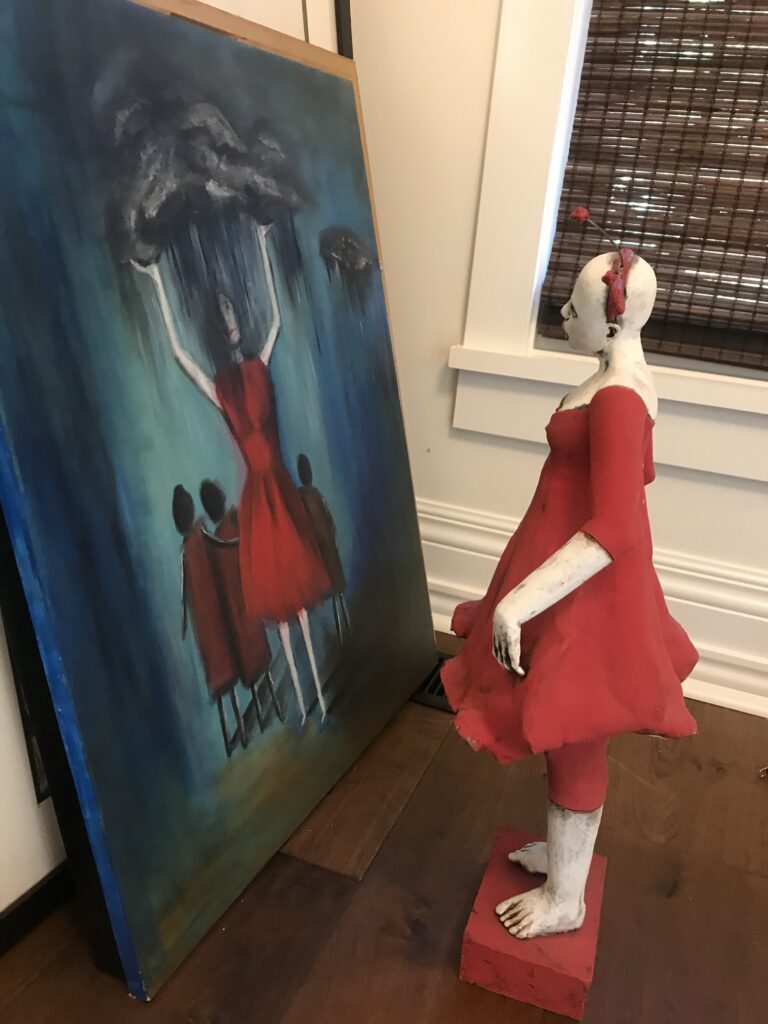
My red-dressed lady, curious about the red-dressed lady I painted. Soul sisters, united.

We were close to the door, and I had my credit card in my hand. Then Buzz, the plumber, set down his pen and invoice pad on an end table and told me he really liked my art collection and wanted to know more. Buzz was recommended to me, and this was his first time in my house. He had repaired my running toilet, but didn’t seem in any hurry to leave.

I thanked him, then asked if he’d prefer Venmo, a credit card, or a check if that were easier. He didn’t take the bait. Instead, he asked how long I had been collecting art and if I had spent time in Santa Fe.

I moved away from the door and back into the room. I was intrigued by his comment about my art collection. It was the second time someone had commented on my being an art collector, and the second time the comment struck me. I don’t know why, as I have collected art for the past 25 or so years, mostly from my travels, and am lucky to have the wall space in my house to showcase my collection. Still, I never thought of myself as a collector because it sounded too pretentious. I also collect books that line floor-to-ceiling shelves of a wall in my front room, which I’ve never called a library for the same reason.

I told Buzz that yes, I had been to Santa Fe many times, and we used to vacation there during spring break when my children were young, and they had all learned to ski there. I added that it was probably where my art-buying began. I should have left it at a yes, full stop, and focused on the task at hand… paying the bill. Instead, my comment opened the door to conversation. Buzz wasn’t picking up his invoice pad any time soon. He got comfortable.

He told me there was one particular painting he liked. It was in my living room, at the opposite end from where we were standing in my shotgun house. I was not going to get the fast exit I wanted. Instead, I followed Buzz to the back wall of my living room, where he stood in front of a large painting of a small house, with a big sky and storm clouds above it. I bought it shortly after moving to Boulder because it reminded me of my drives across western Kansas. He was looking at the painting as no one else had, except me, while in the gallery contemplating the purchase.


“This painting makes me happy. Beautiful art like this makes me happy. I mean, come on… that sky! You can almost feel the wind, can’t you?”

I looked at the painting, I mean, really looked at it, for the first time since I stood in front of it at the gallery. He was right. You could almost feel the wind.

I’ve had many people compliment me on the art in my house, but nothing like this. Next to the painting were four photographs I had taken in Peru and Nepal — close-ups of faces that intrigued me. He asked me where they were taken and why those people? One was of a young, Nepalese girl, her hands in a prayer, and the other three were elderly women from the center where I volunteered in Perú.

“It was the stories they weren’t telling. Their experiences, without words,” I told him.

He nodded and said he understood. He said photography was his first love, but plumbing paid the bills, so of course, he understood. When he was finished giving his opinions on the rest of the art in the room, we started walking back to where we started. I assumed we were wrapping things up, but he stopped in my kitchen and commented on two other photographs I had taken.
“You see things deeper than most people, or differently.”


I wasn’t sure what he meant. He explained.

“I can see that about you because, as a photographer, I don’t photograph what is present, but what isn’t. You do the same, both in the art you’ve chosen and in your photography. I had never heard that before. I went from wanting him to leave to thinking I should put the kettle on.

We returned to the front room, and he shared more stories about his photography and his art collection, which, due to space limitations, he had started selling. He told me about specific artists whose work he had purchased on Canyon Road in Santa Fe. Clearly, he was a serious collector. I was just someone who knew what she liked but couldn’t remember the artists’ names who graced my walls.

He took out his invoice pad and started writing again, then stopped, set it down again, and asked me about the small sculpture of the woman in the red dress that sat on a table in my front room. I’ve heard many strong opinions about my red-dressed woman, including from my realtor in Kansas City, who insisted I put it away before she showed my house to prospective buyers. She found it creepy. Emery also found it creepy, but her daughter, Muna, loved her. To each their own. He looked at her, without voicing his opinion (surprising), then looked into my nearby office and saw my painting of a woman in a red dress with three children. I told him I had taken several painting classes in the time leading up to my divorce and that I called that painting my divorce painting. The red-dressed sculpture was one I bought after my divorce. I shared her history with him.

“I saw the sculpture at Jazz Fest in New Orleans and made my way to the artist’s booth every one of the three days I was there to look at her. On my last day, I returned to the booth, picked up a smaller, less expensive figure of a girl in a white dress, and told the artist I wanted to purchase it. She was confused because it was the red-dressed girl whom I had become obsessed with. We went back and forth, and I finally told her the truth. The red-dressed girl was more than I wanted to pay, so I was compromising.The artist told me she wouldn’t sell me the white-dressed woman because it was not the one I wanted. She ended up reducing the price so I could buy the one I wanted. It still felt like too much, but given the lengths the artist was willing to go, I had to say yes. When I got home, I put her up on my mantle. The divorce painting was on the wall next to the fireplace. When I saw the two side by side, I knew why I had been so drawn to her. They were soul sisters, separated by space and medium. ”

Buzz liked the story and told me once again that art made him happy, and his saying that, while standing in front of my art, made me happy.

Fixing my toilets took less than an hour, but the art discussion that followed was almost as long, and I was glad for it. He handed me the bill, I gave him my credit card and he wrote down the numbers because he didn’t have a card reader, and then he was gone. The conversation about art, however, was not, and would continue the next day, albeit with his wife. She called me because my credit card had not gone through, and before saying anything else, told me Buzz really enjoyed my art while in my house. She also noted that her art-loving, photo-taking plumber husband is dyslexic and struggles to write numbers correctly, especially when he’s in the throes of an art discussion. She read the number he had written down over the phone, and I corrected her on the transposed digits.

After my Dad died last year, my cousin told me to look for sparkles every day. She told me again after Emery died, and this time, I was more mindful of her words. Sometimes the sparkle is so well disguised that you’re trying to rush it out of your house so you can get on with your life, until you realize that the detours and the pauses are life. A broken toilet and an artist and critic disguised as a plumber were my unexpected sparkle, which ran deeper than the relief of a functioning toilet.

Now, when I look at my painting of the small house and the big sky with storm clouds hanging over it, I recall what Buzz told me.

“Art really makes me happy.”

It does me too, Buzz. I just forgot.