The moments that your heart holds tight….

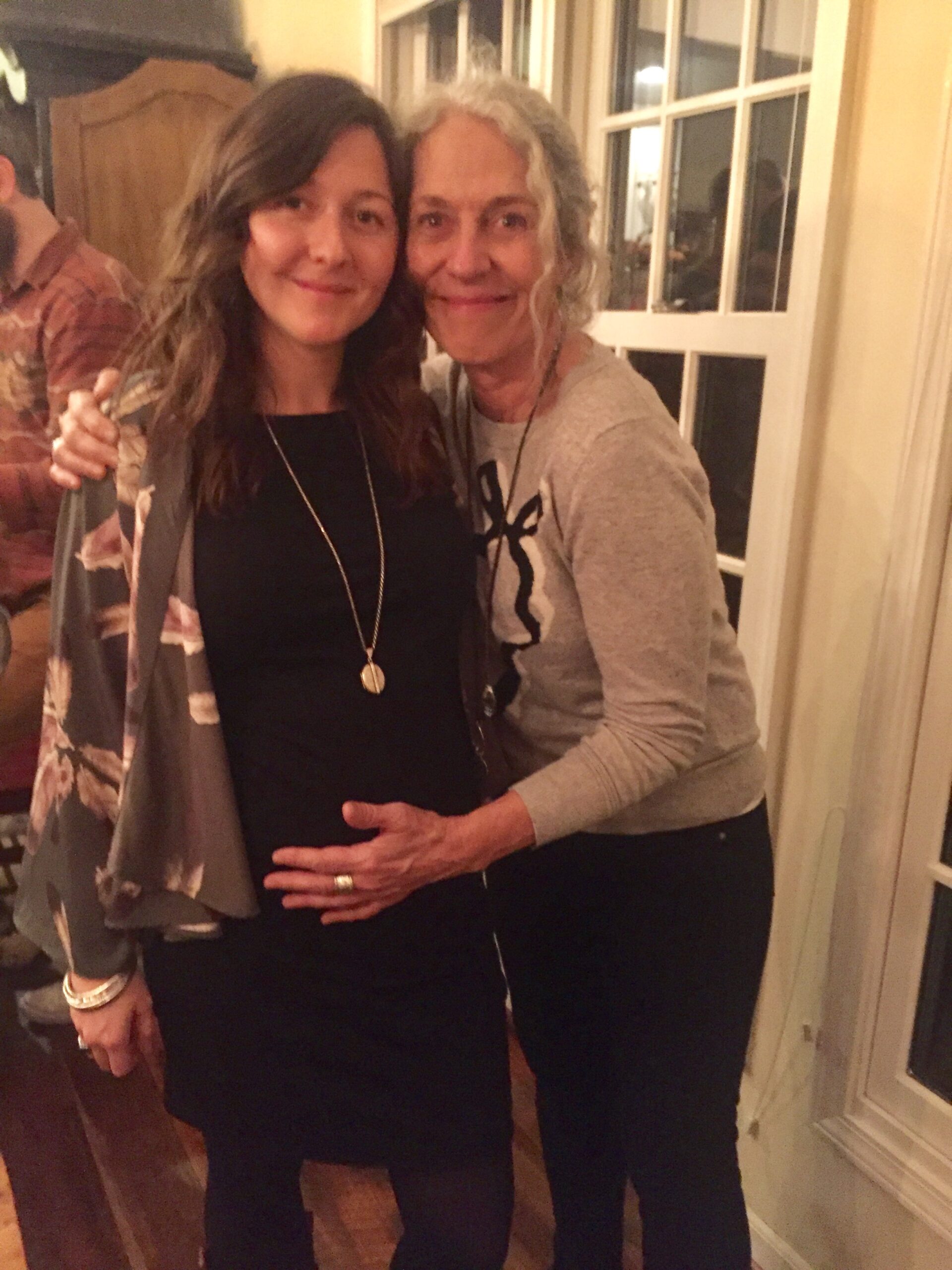
It’s the small things in life that seem to hold the most real estate in my heart – not from birthdays or weddings or special holidays, but rather, the moments from every day life that surprise me and have me wanting to push the pause button and absorb it before it moves past.   I had one of those moments on my last morning in Colorado, while staying with my daughter, son-in-law and 10 month-old grandson.

I was sitting on an ottoman that I had pushed up in front of the windowed door to the deck with my grandson,  Arlo, on my lap.  It was early morning and the sun was still making it’s last climb over the horizon, leaving a soft yellow glow in the house; that very peaceful time of day when everything seems to move a bit slower, including 10 month-old babies.  A herd of 20 or so mule deer were slowly making their way across their land, close enough to the house that they were easily spotted by both of us, even though their coats were camouflaged against the color of the winter grass.  When Arlo spotted them, he quickly looked up to me to insure that I also saw them, then pointed his small finger at them,  looked up at me again and smiled.  Arlo is a very busy, very mobile baby, so the  moments seemed borrowed in a way and I held onto them as long as I could as I knew while it was happening that it was a moment and a feeling  I’d later savor.

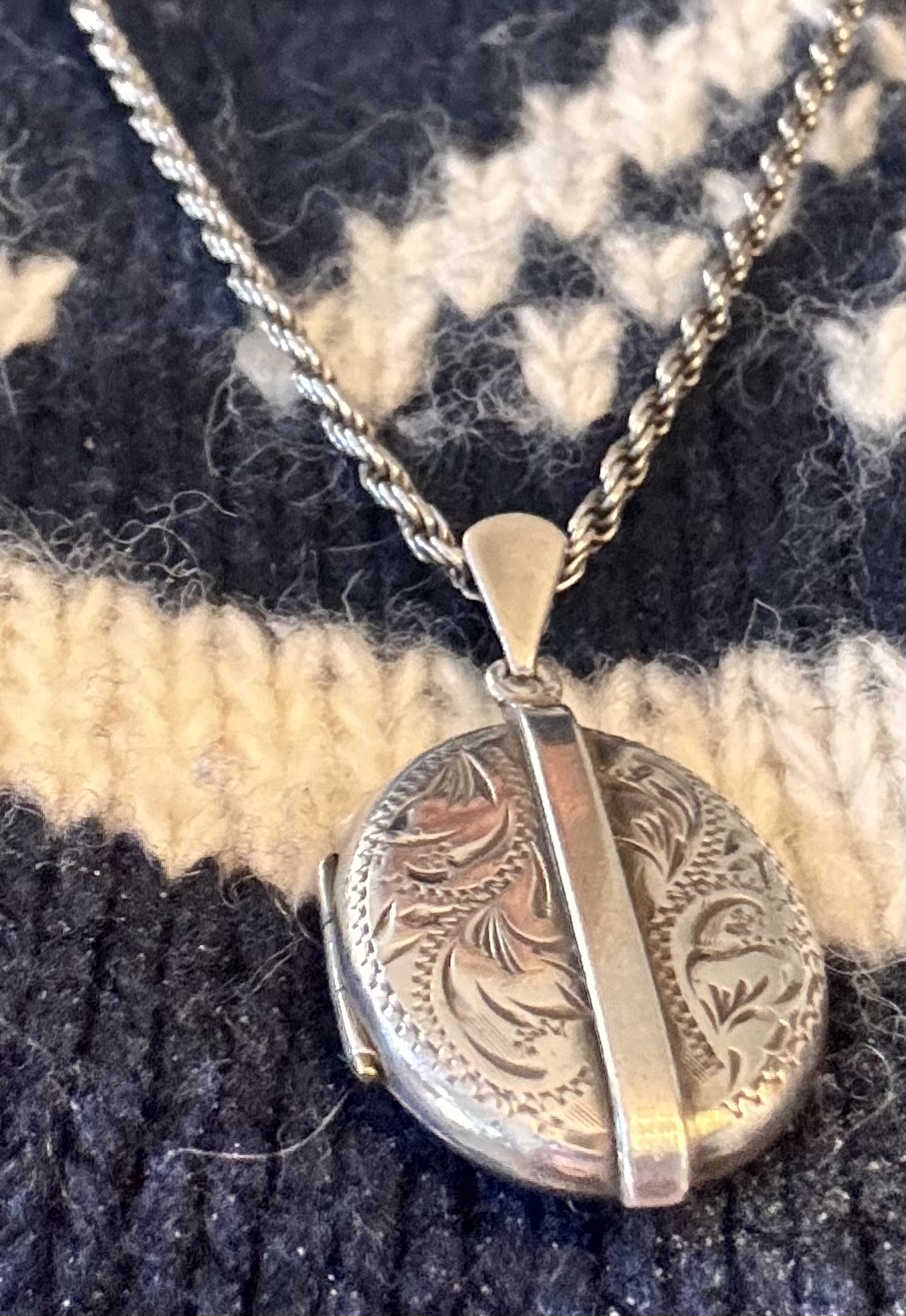
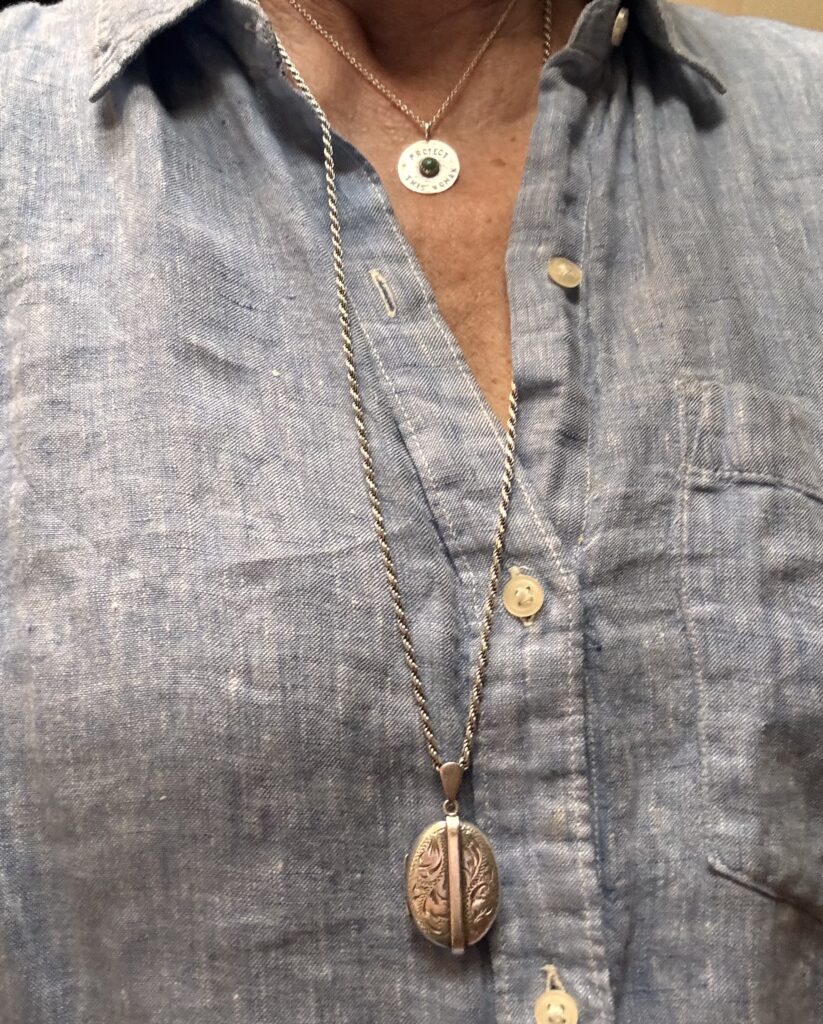
We sat there  for several minutes, quietly watching as the deer slowly made their way across the land behind the house, Arlo’s eyes wide with fascination. When he had seen enough, he turned his attention towards me and  grabbed my necklace, as he often does because he’s a baby and that’s what babies do, but this time he held it in his small hand as if he was really examining it, rather than simply trying to pull it off of my neck.  It’s a small silver disc with  the words “protect this woman” surrounding a small turquoise piece in the center.  I’ve worn it continually  around my neck for the past 5 years.  He seemed very curious about it.  Someday, Arlo, I will tell you about the day that I found the necklace in a small shop in Leadville, CO.  I will tell you that in the previous months, I had climbed to the top of five 14,000 foot peaks, by myself, and although I have a weakness for silver and turquoise, it was the words on that small disc that had me buying it without hesitation.  I’ll explain how even though it is only a piece of jewelry that I wear around my neck, somehow, it makes me feel just a tiny bit safer.  I’ll show you, someday, what it felt like to climb those five tall peaks and will give you the handful of tips I discovered  as we climb them together.

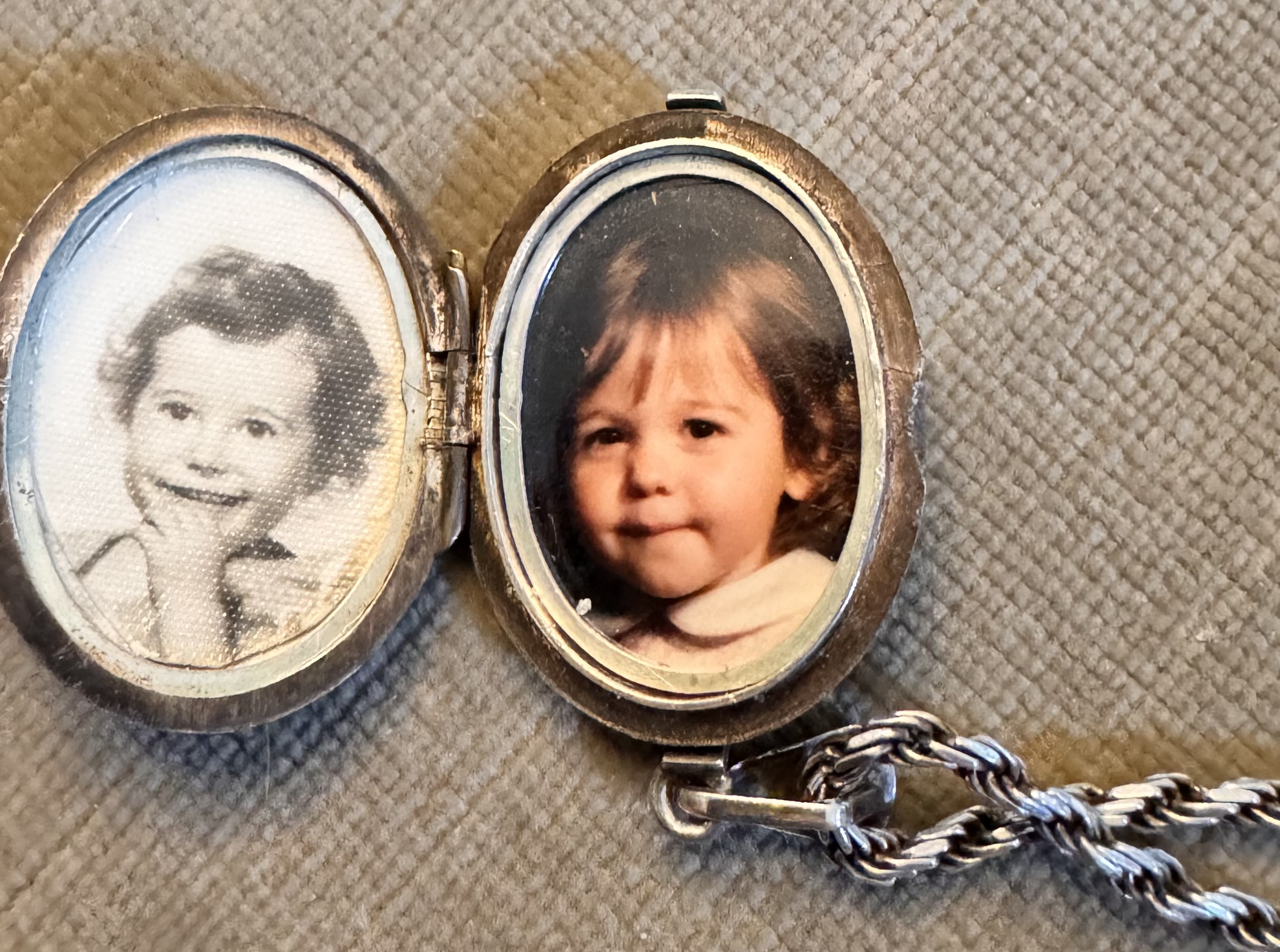
I will also tell you about the first morning after my young family had moved into our new home,  when your Mom was not even three,  and I saw a huge buck circling the large cedar tree in the front of our house and how mesmerized I was by the site of him and the fact that there he was, right in our own front yard. There’s just something about watching deer so close to where you live in the early morning hours.   I’ll tell you that those 5 acres that surrounded our new home made me feel like I was living on a ranch as I had never lived in a place with so much land around me.  You’ll laugh about that one, no doubt, as living with a lot of land around you is all you have known, but that’s ok.    At some point, I’ll  tell you the rest of my deer story… the part where the deer could wipe out days of work in my garden during their early morning feedings and how I spent countless hours and endless experimentation trying to deter them.  Even so, that morning when I saw the buck circling the cedar tree, just feet from our front porch, still wins on the deer memories for me.  Did I mention that it was snowing lightly that morning?

As I sat there in the quiet house, with Arlo  on my lap, I felt the awe of the role of Grandma that I was blessed with a short 10 months ago.  It’s a role that I covet dearly, first, because I am a mom and to see my baby take on the very role that shaped the biggest part of my life is beyond miraculous to me.  Second, because of my own grandparents and the important role they all played in me becoming who I am today.  My love of knitting, sewing, gardening, photography, writing and love of travel were all introduced to me by my grandparents, whether directly with a hand reaching over mine as I held a red plastic knitting needle as it formed stitches or indirectly, simply by exposure.

The silver bangle that I’ve worn on my right wrist since I was 16, is one of many continual reminders of their influence  in my life.  I can remember my maternal grandmother, always with an armful of silver bangles, and the noise she would make when she entered a room.  Her granddaughters were each given one of her bangles when she died and I’ve carried that little bit of her on my wrist ever since.  There are other reminders that come in flashes – the first bloom of the iris in the spring, a well-written, witty letter, a bolt of fabric with its limitless possibilities when a sewing machine and a lot of patience are added, skeins of yarn and needles and the hope of sweaters that will fit and the ever present  camera that resulted in boxes and boxes of  beautifully captured photographs.  These are the pieces of my life that have given me my sense of passion and have pushed my creativity in ways that continue to challenge me. If I can contribute in  a similar way to my own grandson’s life, I will feel like I’m not only sharing some of who I am with him, but I’m giving thanks to my own grandparents in the process.

Last week, I was in a baby store shopping with someone who I’ve called my best friend since I was 15 years old.  She was shopping for her  6 week-old grand son, and I was shopping for Arlo.  We hadn’t been there long when it hit me and in between the oohs and ahhhs and is this cute?  too cute?  and how big will he be in 6 months?,  I stopped,  pondered the reality of the moment, and commented.

“Look at us….friends for 3/4 of our lives, you living on the east coast for most of it,  and me in the midwest,  and here we are, in a baby shop in Breckenridge, Colorado, shopping for our grandsons.  Could you even have begun to imagine that out of all the searches we made together… the clothes,  the parties, the guys, the fun the beer and the cheap clothes and babysitting jobs to pay for those cheap clothes and maybe someone with a fake ID to buy the cheap beer, that someday our search together would be for baby clothes… for our grandsons???”

A beautiful passage of time seemed to have had us both in its collective hug and the 46 years had brought us to a moment that I think caught us both off guard.  We became grandmas for the first time 9 months apart and after sharing so many firsts, we’re sharing one again.

So, Arlo, that moment we watched the deer with the sun rising at our backs, tucked away in the quiet of the house  with you seated on my lap,  was one moment of countless moments to come.  I have so much to tell you and share with you and if just one of those many moments impacts you enough that someday you’re sharing it with your own child or grandchild, or really anyone, then I will have succeeded and that yarn of all of our collective experiences will continue to knit the stories that will connect the generations.   We  are all a part of the creation of something quite beautiful – stitch by stitch, row by row, that continues to grow.

Stories for my Grandchildren

Today,  I am seated on the same blue couch I sat on a year ago, looking out of the same picture windows at the same spot on the Oregon Coast.   I remember the story I wrote that day after being moved by what I had seen earlier at the beach.  The story has stayed with me and has become far more relevant and meaningful over the past few months than the day I wrote it. 

I had witnessed a small gathering of people standing shoulder to shoulder at the water’s edge with their faces and attention all towards the sea.  I was drawn to their stillness and connection to something I couldn’t see but could feel.  As I got closer, close enough to see the individuals in the group, while respectfully maintaining my distance, I saw someone seated in front of the group who appeared to be younger than those standing.  She wore a yellow raincoat.  The person at the end of the group moved next to the girl, squatted down, put his hand on her back, and handed her a box.  The girl held the box to her chest, then returned it to the man, picked up a stick, and began carving something into the sand.  When she was finished, the man returned the box to her and the group slowly walked away from the water in a single file, with the girl in the yellow raincoat trailing behind. I had walked away from the group, not wanting to intrude, and when I returned, I saw the letters MA carved into the sand.  The tide may have erased the first part of the word,  or maybe that was all she wrote.  Was it MA?  Or were they the last two letters of MAMA?  I wasn’t sure, but the image drawn beside it was unmistakable—a heart.

I may not have gotten the details right, and that didn’t matter, but what I did get right was the witnessing of love that the line-up of people had for someone who was no longer with them. It made me think of my three children and what they would look like had it been me who they were honoring and mourning. A year later, that is not the story I’m telling.  Instead, it is my two sons and I who are metaphorically standing at the water’s edge, mourning the passing of my sons’ only sister and my only daughter. It’s not the order of life we expected, and we still grapple with the reality that it happened. My daughter, Emery, who was not even as old as I was when I gave birth to her, is no longer with us. Of course, Emery’s metaphorical lineup at the water’s edge would be much larger than just me and her two brothers and would include her father, her husband, her two children, and her two sisters-in-law, for starters.

Emery was always my first text after I’d post a new blog.  She’d praise my words, noting specific parts that moved her or made her laugh, indicating that she had read the piece and wasn’t just giving me a quick “ I loved it!” acknowledgment. I remember her text after I posted my story of the lineup of people on the beach, and I could quote her exact words if I felt brave enough emotionally to scroll through her texts, but I don’t.  She later told me she could see herself and her brothers doing exactly what I said in the piece…“Talking over each other and interrupting with stories about Mom because there had been so many, but she should be here telling them because she was the storyteller.” I won’t get her response to this post.

Witnessing what I did that morning had me thinking about my death and how my family would react.  It’s not something that I think of often, but after seeing the group of people mourning someone they loved and leaning into each other in sorrow, thoughts of my death were softened by the love that has woven us together as a family.   I never thought it would be the youngest family member we would be saying goodbye to first.

This morning, a year later, I thought about the girl in the yellow raincoat, who I guessed to be a young teen.  She was the one I related to, especially after seeing the letters MA  and the heart carved into the sand.  As a Mama who said goodbye to her daughter, who was also a Mama, I became the girl in the yellow raincoat.  The oldest and the Mom in our family of five made an unlikely connection with the youngest in the lineup of people on the beach because of a heart drawn in the sand and two letters that I have turned into the word Mama for the story’s sake.  She missed her Mama, and I am a Mama who misses her child.  We have a connection.

Back in the mid-70s, when I was getting my pilot’s license, I became close friends with Leigh, who was also in her late teens, working on her pilot’s license.  Leigh and I connected with our experiences, enjoying each other’s stories far more than anyone else would.  Several times a week, we’d return to the fixed base operation at the small regional airport where I worked after closing. She’d park her car at the edge of the tarmac, and we’d lay on the car’s roof, looking at the stars and watching the lights of the planes as they descended onto the runway while passing a bottle of Cold Duck back and forth. It was a rich environment for sharing dreams, most of them in the skies.  Our conversations were punctuated by “this will be something we will tell our grandkids” because we thought it would be our role as grandmas to share stories that would have our grandchildren on the edge of their seats. It became our tagline and our push to do things that scared us — more stories for our grandchildren.  I had no idea at the time that the stories I would be telling two of my grandchildren would not be about my flying escapades but rather would be stories about their Mama, some that only I could tell them.  I will tell them the stories their Mama won’t be able to tell them. I will be the one to tell them she loved red shoes as a little girl, twirly skirts, and could French braid her hair when she was in kindergarten.  I will tell them she had a deathly fear of silverfish, and it had nothing to do with the holes they made in coveted sweaters.  I will tell them that for many years, she would only eat yogurt if it had goldfish crackers in it, and so that’s how I prepared it for her.  I will tell them I sang to her at night until she was old enough to sing along, and it became a nightly show rather than a peaceful transition to slumber.

In the same way, I would sit with my Dad in his last few years and ask for more stories, so afraid he would die before I had them all, I need to make sure Arlo and Muna have all the stories I can remember about their Mama.  It will be healing for me and information for them. I will feel Emery’s presence as I ramble on to Arlo and Muna with stories about their Mama. I will feel her beside me, nodding and smirking, then saying, “Well, that’s not exactly how it happened…”. And I’ll look back at her with raised brows, and she will correct herself and say, “You’re right and some exaggeration is OK because you’re the storyteller and you have a captive audience.”  At least, that’s what I imagine.  In telling my daughter’s stories, the edges of the missing part of my heart will soften. Salve to my heart will become information for Arlo and Muna.  I thought about the “stories we will tell our grandchildren”  while walking on a beach a short drive from where I’m staying. A few minutes later,  I noticed I had missed a call from Leigh.  We hadn’t talked in over 15 years.  I sat on a rock to listen to her message and saw a heart-shaped rock in the sand, directly in front of my boot. I looked up, half expecting to also see a red-tailed hawk, but only saw a seagull.   Emery is with me, and she’s making sure I know it.

As I returned to my car,  a couple reading the trailhead map at the edge of the parking lot stopped me and asked me if it was a hard hike down to the beach.  “Hard?  No, not at all.  It’s very easy and quite lovely.”  They thanked me and were on their way.  I paused, wondering why I had done what I did, responding to their question with the information they wanted but with a definite British accent.  I don’t normally respond to people I don’t know with a British accent.  Actually,  I’ve never done that before in my life, but there are many things I’m doing now that I’ve never done before as I’m navigating an unpredictable path. The only explanation I could come up with is that during these heavy days of sadness and grief, I don’t always want to be who I am.  I don’t want to be a Mom who has endured something that no Mom should ever have to endure.  Instead, I became a British woman, perhaps on holiday, enjoying a short hike and an afternoon at the beach.  Maybe someday, that will be added to the long line-up of stories I’ll tell Arlo and Muna.  The story of grief being so difficult to maneuver that their Laudie pretended to be someone else and spoke with a British accent. 

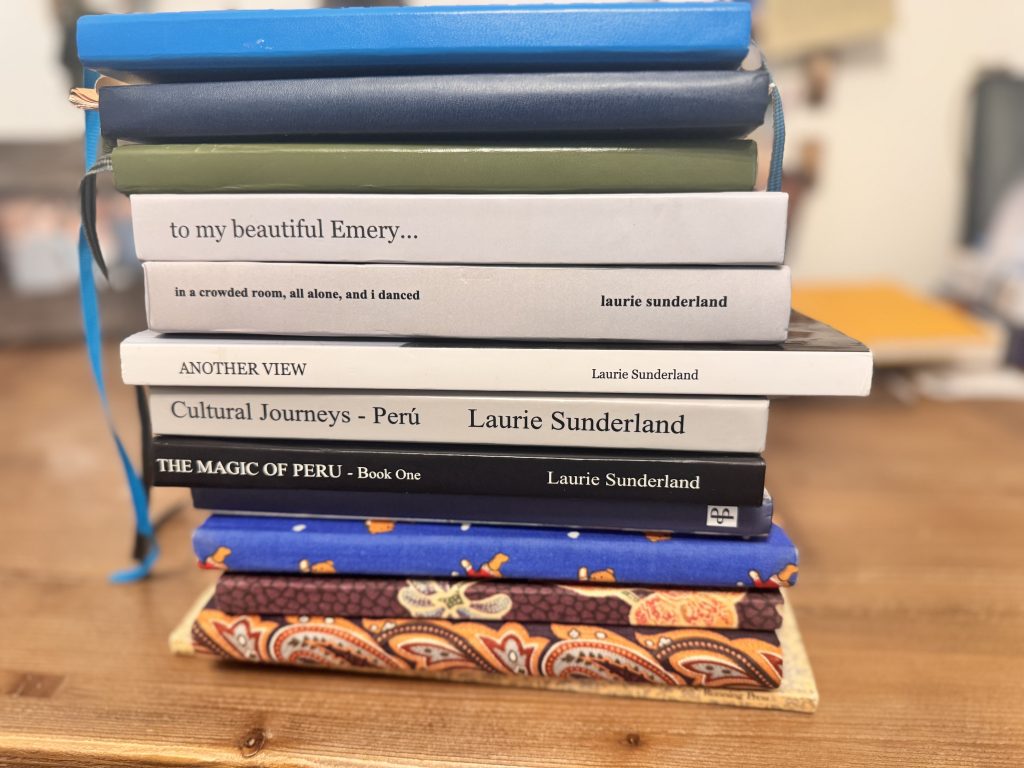
Many of the stories I will share with Arlo and Muna were recorded when they happened in journals and essays I’ve written and collected since the day I found out I was pregnant with their Mama.  As I sit here today, on the same blue couch, looking out of the same picture window to a part of the country I’ve come to love, I think about the girl in the yellow raincoat.  I wonder if, a year later, the raw edges of her grief have been softened and if she asks the others who were with her that day to tell her more stories because when there is a finite number, they hold more weight and importance than ever imagined before.  The words I write today,  tomorrow, and for the rest of my life, will be the stories l tell my grandchildren when the time is right. They are words inspired by my beautiful girl, Emery, written by the one she called Mom while in the throes of grief that I never could have anticipated.  

Once upon a time, your Mama…” I’ll say,  and Arlo and Muna will lean in, holding onto every word then will carry them as their own.

Words for Emery

(that I never thought I would write)

01/19/2025

As a writer, I have always found comfort and solace in words, much like other family members find in music and art.  Words have helped me make sense of the world and have given me a portal to express myself, whether I’m sharing my work with others or for my eyes only.  I’ve opened my computer countless times these past two weeks, but words fail me. Instead, when I open my computer, I find myself going through photos of Emery. I linger on the ones of her as a little girl because the more recent memories of my girl as a woman, a wife, and a mother hurt my heart too much now.  Funny stories came to mind, but I wondered if they would be appropriate for Emery’s celebration of life…a time of reverence, respect, and awe.  Then I felt Emery’s nudge…and her telling me, “Celebration, Mom, focus on the celebration part and tell the stories.”    And so I will.

My Flower Girl:

Like many children, Emery never wanted to go to bed, whether at night or during afternoon naps.  When most children her age would be put down for naps in their cribs, Emery would try to persuade me to let her nap on the couch, “mostly to keep me company.” I caved more often than I should have because I loved having her curled up next to me on the couch, pretending to sleep while I pretended to read.  One of my nighttime techniques to help her fall asleep was to sing to her.  I am not a singer, by the way.  I don’t remember how, when, or why, but the song “I Love the Flower Girl” by the Cowsills became my nightly lullaby.  When she was old enough to sing along, it became our duet, with hairbrush microphones in hand.  This hardly ensured Emery’s entrance into slumber, but it was fun, and we loved fun, so it became our routine and “our song.”  

Emery grew up loving flowers, and at an age when most of her friends didn’t know the difference between a daffodil and a daisy, she could name every one of the perennials and shrubs in my very large garden… in Latin because that’s how I taught her.  When she was in kindergarten, she started calling my garden “the garden of love.”  She decided she wanted her kindergarten teacher, Miss Lindner,  to get married there and began to make plans.  She  knew where Miss Lindner would enter the garden, under the rose trellis, of course, and where her husband-to-be would be waiting for her.  She told me we would need to call the newspaper.  I told her Miss Lindner needed a boyfriend.  She dismissed my concerns and said we needed a photographer.  “Could you be the photographer?” She asked.  I told her I’d be honored.  Miss Linder did not get married in our  “garden of love,” but we did attend her wedding two years later.  As we watched Miss Lindner walk down the aisle, we looked at each other, smiled, and nodded.  Our thoughts were on the same thing… our garden of love.  Truly, my flower girl. 

Marley:

Emery’s love of animals ran as deep as her love of plants.  When she was in kindergarten, we adopted our beloved yellow lab, Marley.  On our first visit to the vet, a female doctor came into the exam room, introduced herself, and told us she would be right back.  Emery asked me why the veterinarian was a woman.  She had opened the door to a conversation I loved having with her about how women can do the same jobs as men, but before I could finish my point, she interrupted me and said, “Oh, I know that, Mom. I was just wondering why Marley’s doctor wasn’t a dog because wouldn’t a dog understand our Marley better than a person?  I started to explain to her that a dog wouldn’t be able to tell us what Marley needed but stopped because I wanted to savor how her brain processed life through the lens of love.  Emery and I would be in that room together, curled up on a blanket next to Marley, 12 years later, when we had Marley euthanized.  She asked me why it hurt so much.  I told her because the deeper the love is,  the more painful the goodbyes are.  I told her this when her Gramps, my dad, passed in September.  I’m telling myself this now.

Not long after that, she asked me when the world turned from black and white to color because there were pictures of me and her grandparents in my photo albums that were black and white, and the photos of her and her brothers were in color.  “Was I there when it changed?  Was it amazing to see everything turn to color after it had been black and white? she asked me.  Another question I needed to savor first and explain later.  Emery saturated the colors in life in the way she saw things, and in doing so, she changed the way I looked at life. As alike as we were, I had one trait that she told me she could never understand, and that was my love of a gray day, a sad movie, a melancholy song, or a long string of rainy days. Emery wanted the sun and the saturation of colors that came with it. Emery needed the sun.

There are no words that can carry the depth and weight of the emotions and love I will always carry for Emery.  Nor should there be because feelings this deep cannot be defined by words but rather can only be felt in the depths of our souls. A part of my heart left with her because, as her Mama, I couldn’t let her go alone.

I want to end with words I wrote to Emery in November 2012 as I grappled with my emotions of letting her go to begin a life with Miles the following year.

Sometimes I look at you, and you are four years old — with chubby arms and legs, wild hair that you refuse to let anyone but you comb, and you don’t, and a twirly skirt that you enjoy keeping airborne while revealing your mom’s lackadaisical dressing style because you have no underwear on.

You are not four years old, and I am not the mama of a four-year-old, yet somehow, in my teaching you how to fly, I forgot to teach myself how to let you go.  I’m watching you fly while I desperately try to remember exactly when your feet left the ground because one day, I was carrying you, and in what seemed to be no longer than a restful pause, you were carrying yourself.  When you were handed to me in the hospital, I felt like I was holding onto a big part of my heart.  I still do.  And just as you told me when you were little and what we still say to each other every day,  I love you with my whole heart.  Really, really, for my whole life.

Soar through the skies, my beautiful Emery.

Continuing Tradition with 24 Beats

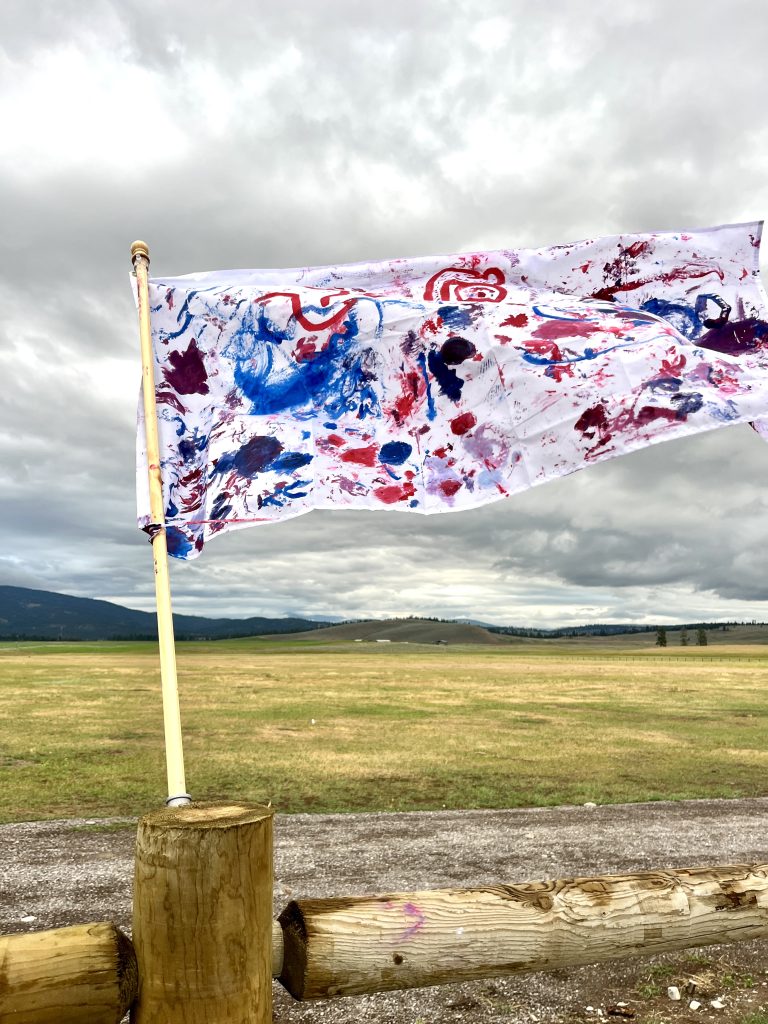
Dad started what would become a tradition when he and Mom moved to their retirement home 15 years ago.  I don’t remember if it was Veterans Day, Memorial Day, or the 4th of July, but on the first patriotic holiday after moving in, Dad went to their patio and played taps.   He told me he didn’t know if anyone else could hear it (adding that most had compromised hearing, so probably not), but even so, he felt it needed to be played to honor and respect the many Veterans who had died.  His playing was noticed, and so it continued and soon became his tradition.

When our family was at Dad’s interment ceremony at the Veteran’s Cemetery in Higginsville, Missouri a few weeks ago, the ceremony began in a small chapel. I transported Dad’s ashes again, although this time in the back seat of my car as Mom was riding shotgun. When we arrived, the urn of ashes were placed on a small table in the front of the chapel with the tricorn folded flag in front of it.  Two uniformed service members unfolded the flag and with ceremonial respect and measured precision, refolded it before handing it to our mom.  A lone bugler, who was positioned outside the chapel,  played taps as the flag was being folded. I was Ok, or as Ok as one is when their father dies, until I heard the sound of taps being played.  I thought about the many patriotic holidays when Dad played taps, whether anyone could hear it or not. Today, with the urn of his ashes on the table while two uniformed servicemen refolded the flag, I realized the significance of an unknown bugler playing for a man they had never met – the same man who never let a patriotic holiday go by without playing taps on his patio for the soldiers he knew and most that he never would.  Someone was playing taps for Dad. With that realization, my tears flowed. Dad would have loved the precision of the military ceremony and the respect paid to him, but most of all, he would have loved the sound of the bugle being played in his honor and having his family present to witness.

Taps is a 24-note melancholy piece of music played by a single instrument, usually a bugle or a trumpet.  It began as a last call before lights out that was played on military bases. It eventually evolved into the familiar solemn farewell that few can hear without being emotionally touched. It is played slowly, respectively, and never with embellishments. 

I miss you, Dad, especially on days that held such deep meaning to you.  It took me hearing taps at your funeral to understand why playing the 24-note piece became not only your honor to those who lost their lives in service, but your personal obligation. Today, on Veteran’s Day, I have no doubt that someone will play it for you, in your honor.

Unexpected moments.

Two different versions of pensive…

When I got in the car after carefully placing the cargo in the front seat, I texted my siblings and told them Dad was riding shotgun and I was on my way back to Mom’s.  I hesitated before sending it, wondering if it was inappropriate or possibly disrespectful, but then realized it was exactly what Dad would have said had his dad been riding in the passenger seat in an urn that sat in a box, placed in another box in the front seat.  Because Dad was a veteran and will have his ashes interned at a military cemetery, his ashes were accompanied by a flag given to me at the funeral home, appropriately folded into the symbolic tricorn shape with no red or white stripe showing, only the blue field with stars. Picking up his ashes in a Kansas City suburb at least 30 minutes away without traffic was a task on a list of things that had to be tended to and one I said I would do as I had a free morning.  I’m glad I agreed to what now felt like an honor despite the rush hour traffic I had to go through to get there. When I glanced over to the passenger seat and saw the box with the tightly folded flag sitting on top of it, I knew it would be a moment I would recall later and more than likely write about because it was a new experience for me because it was my Dad, or his remains, as the funeral home now referred to him, who would make this a story and not just something to check off in a long list of things that needed to be tended to.

When we made our initial trip to the funeral home to sign papers and go over details after Dad passed, my brother, Tom, in preparation for being the one to pick up the ashes, asked if the urn had a screw-off lid; we had been seated around a dining room table in a room that looked like it had been decorated to make families feel at home.  Except for the display of jewelry that could be purchased with your loved ones’s fingerprints in the center of the table, it felt like an informal gathering around a dining room table. I don’t recall the woman’s title who we were meeting, possibly the owner, but she took her place at the head of the table after helping Mom into her seat and pouring water for everyone.  Once seated, she smiled at my brother and said he was not the first to ask the question.

“Yes, the urn has a screw top lid, and the ashes are in a bag.  The urn is then placed in a box, and that box is placed in another box. No need to worry about ashes ending up on your front seat.”

I appreciated the break of solemness with the dose of reality.  The subject was difficult, and I was learning the importance of finding the humor and breaking out in laughter as often as possible. At this point, it felt not only good, but necessary for the soul.

It wasn’t my first time transporting ashes.  Several years ago, the container of ashes of our yellow lab, Marley, rode in my lap when our family took them to our farm to scatter.  I remember thinking the container was heavier than I thought it would be, even though Marley’s weight was down considerably when we had him euthanized.  Unlike Marley, Dad’s ashes will not be scattered but will remain in the urn and be interred at a military cemetery.  I couldn’t help but glance over to the box, which didn’t look the least bit out of place as boxes often rode shotgun in my car en route to the post office to return something, but never with a flag on top.  I turned off the music in my car because I wanted to talk to myself or, if I’m being honest, maybe to the box and the spirit that filled my car. I knew the box only contained the ashes of Dad’s body and not his spirit, but it gave me the same feeling as talking to the headstones of my grandparents when I used to go with Mom and Dad on Memorial Day to lay flowers on their graves.  On one such trip, Dad had no blooms available for cutting in his garden, so he stopped at a convenience store and picked up a small bundle of plastic flowers.  When he put them on Grandma and Papa’s graves, he added a note that said, “Sorry about the flowers, Dad, it was the best I could do.”  His dad raised hybrid irises as a hobby, so he knew flowers well, and the apology was appropriate. Conversations graveside on Memorial Day were not solemn for Dad but rather practical.  I followed that lead while conversing down Blue Ridge Boulevard with the box of my dad’s remains riding shotgun and I was smiling for most of the journey. Afterall, I got my humor from my Dad.

I was blessed to have Dad for the entire 69 years of my life, and I’ve seen most of my friends go through this process some decades ago. I had to wonder if they felt the confusion I did right now of grappling with the fact that my physical dad was gone.  Forever.  I will always carry him inside of me — his humor, his smile, his generosity, and the way he viewed life, but never being able to call him on the phone and follow his sometimes indirect storytelling path is hard for me to wrap my head around.   His cell phone has been deleted from his T-Mobile account, and I went through his phone beforehand to make sure he didn’t have any unanswered messages and to check his contact list to make sure everyone had been told about his passing. Still, I can’t take his number out of my phone.  And I’m struggling with using the past tense when speaking of him.  I wonder… do these issues fade in time?  Become more natural?  More comfortable? More familiar?

Dad was 96 and had a very good life for 95 and 3/4 years, and that is what I keep reminding myself.  A few days after Dad passed, my sister, Susan, and I went to our usual coffee spot near our sister Robin’s house in an urban setting of Kansas City.  Exiting the car, we saw a red-tailed hawk perched on a fence post.  As hikers, we both were familiar with the bird of prey, but not in an urban setting.  Susan looked at me, and I looked at her, and we both nodded.  Dad.  After an hour in the coffee shop, we returned to the parking lot, where the hawk was still sitting on the post.  This time, there was no question.  Dad.  I later read that “the sudden appearance of a hawk may indicate a loved one who recently passed is sending signs through this spirit animal about their continued presence.

We both felt a sense of comfort and reassurance.  A few days later, I felt the same sense of comfort while I looked over to the box that occupied my passenger seat at a stop light and smiled.  You’re still with me, Pops, and I feel your presence. The tightly sealed urn wrapped in bubble wrap in a box that’s in another box with your ashes in it is as close as I’ll ever be to you again physically, but you’ve taught me to be curious and question things that don’t make sense and if you believe something, to trust that belief.  I believe you gave Susan and me a nudge with the red-tailed hawk.

I know that processing Dad being forever gone will come in spurts and not always at the most opportune times.  In the days leading up to Dad’s death and the weeks that followed, the only people I saw were family, nursing staff, hospice care staff, attorneys, bank employees, and the woman who explained the packaging of the ashes at the funeral home.  I’ve been immersed in a place I didn’t anticipate being in on a visit to my hometown to see my sister, Robin, who was recently given the terrible and hard-to-process diagnosis of pancreatic cancer. This process has exhausted me to my core, and I’ve cried more in September than possibly in the entire of my life, yet here I am, still upright, with memories crowding my mind, each one vying for attention.  I worry about Robin while in the throes of mourning my father’s death.

I keep circling back to a letter Dad wrote and tucked into my suitcase when I left for college. He typed his letters as his handwriting was difficult to read, always with the oversized “LOVE, DAD” scrawled across the bottom of the page.  He said, “This could have been considered the 8th wonder because it is not like me to write letters, except possibly to tell some unsuspecting parent that their child wasn’t graduating.” You didn’t know when you typed that letter, Dad, that it would become one of my most cherished letters and give me the idea to do the same with my children.  My kids all got letters that I tucked under their pillows after making their beds in their dorm rooms, something I insisted on doing simply for the letter placement.

“There were times, Laur, when I could have knocked you on your ear, but believe it or not, it was always out of love,” the letter continued.  Several months ago,  Dad had been admitted into the hospital due to issues with his pacemaker and, within 24 hours, was diagnosed with pneumonia complicated by COPD, followed by being intubated, a very dangerous procedure for a 95-year-old.  Two days later, and with much surprise to the doctors, they were able to remove the intubation, and Dad began breathing on his own.  I saw him that day, early morning, and it was just the two of us in the room.  Maybe it was his near brush with death at that time, or maybe I just caught him at the right moment, but we had one of the best conversations we had ever had despite his difficulty in talking.   He told me I was a “real pain in high school, which was a very challenging time…for both of us.” Those words made me smile, and I couldn’t disagree with them because Dad was right.  Then he added that he parented me the same way his dad parented him, which meant ignoring a lot of the behavior and letting me be who I needed to be in the same way his dad had done with him. It was honest.  It was real.  He added that he thought his dad knew he was sneaking out of his bedroom on Saturday nights while in high school and hitchhiking to downtown Kansas City, where he was given playing time with the jazz band The Scamps.  I felt more connected to him in that moment than I ever have—his rebellious spirit clearly having made its way into me, although my stories paled in comparison to his.

The letter ended with, “I’m sure I’ll continue to get upset sometimes with you, but I love you so much and always want the best for you.  And no matter the struggles, you will be OK.” 8/20/73

9/26/2024. Thanks, Dad, for writing those words to me that I read alone in my dorm room, and now, 51 years later, I’m reading again, alone in my living room. I’m holding onto the “you’ll be OK” part with everything I have right now.

Writing Dad’s Obituary

I’ve written things I didn’t want to write, pieces I regret ever seeing the light of day, and countless stories, essays, blog posts, and a few memoirs that may never be finished.  Some pages come easily; others are slogs, but I stay with it if I feel like something’s there.  A few days ago, I was given the difficult task and deep honor of writing my Dad’s obituary.  I  was honored my family gave me the responsibility of writing it, but I also struggled.  Not because I couldn’t find the words or the stories but because I didn’t want to write in past tense.  It was also hard to edit my words to an appropriate-sized piece as I wanted to include far more than would fit into the parameters of an obituary. I called the Kansas City Star to ask them what the average length of an obituary was and was told there was no limit.  She told me they had seen a few at 900 words, which was rare, and if I had a lot to say, 800 words was a good number.  As we spoke, I looked down at my word count.  982.  OK, I told her I’m good.  Inhale, exhale, and start deleting. 

I settled into a table at the back of a cafe with a big cup of coffee and my computer and started typing. I was only a few sentences in when I realized that typing in a public place had not been a good idea, as I was only a few sentences in when I began to sob.  If anyone around me knew what I was typing, I’m sure they would have stopped staring and sent over some tissues. After an hour or so, or about a large cup of coffee later, I finished editing, cutting a few hundred words in the process. The cutting felt painful because who am I to decide what is put in and what is left out when it comes to such a public reckoning of who my Dad was and what he did in his life?  Dad was a storyteller.  He would have also struggled with the assignment.  I felt proud and sad at the same time and made a promise to myself that it wouldn’t be the last time I wrote a piece about my Dad.  I was also sad, because Dad was one of my favorite readers, always with a comment, and this would be one piece he would never read.

Dad was blessed with 96 years, and up until two months ago when he fell, most of those 96 years had been good, with Dad holding onto his attitude of “today is going to be my best day yet,” regardless of what he had on the calendar. 

 I left the cafe with the kind of headache you get after crying, a pain that is felt more emotionally than physically. I got into my car, called my sons who happened to be in town and told them I was on my way to meet them for lunch, then I backed into a truck who was entering the parking lot.  I’m a good driver and can count on one hand how many wrecks I’ve been in with a couple of fingers left over, none of them serious. All I could think of was, seriously?  This is how I’m ending my morning? The couple exited the truck, and the man said, “Oh great, I see you don’t even live here… Colorado?”  “Yes, I do, but I’m here for a while because”… I considered my next sentence as it felt manipulative, but I said it anyway… “My Dad passed last week, and I’ll be in town for a while.”  The woman sighed and told me how sorry she was.  The man went back to his truck in search of paper. Both of our vehicles were damaged, his worse than mine, but both were drivable. We exchanged information, and I got back into my car and cried because I wasn’t sure what else to do, then started laughing because seriously, had I shared with the couple that I had been in the cafe writing his obituary…well, you can’t make this stuff up and it sounded like I just did. 

The events of the morning would have been a great story to share with Dad.  After hearing it,  he would have ensured that I was OK and the person I hit was OK, then would have found the humor in the situation along with the irony.  He was good at that.  Had he been in a similar situation, he would have chatted with the other driver and likely shared a story, ending with a handshake and a laugh. You were the storyteller, Pops, and I was honored to be given the gift to tell yours. 

Bob was often called a Renaissance man, “a fully-rounded person, knowledgeable in many areas, including the sciences, arts, and humanities.”  To that, his family would add that he was the one who got the call when the car wouldn’t start, the disposal was jammed, or help was needed to get an oversized mattress down a narrow flight of stairs. Dad was the first call when a trusted Volkswagen was no longer trusted and needed a tow. He improvised with his equipment more than once by taking his belt out of the loops and using it as the tow rope.  Dad was always available and ready to roll up his sleeves and go to work whenever his family needed him.  This philosophy was also how he spent 28 years working Monday through Friday at Olathe High School, where he was a guidance counselor with an open-door policy to anyone who needed advice, encouragement, counsel, or simply someone to talk to.

Bob was born in Pleasant Hill, Missouri, on August 1, 1928.  He died on September 7, at Foxwood Springs in Raymore, Missouri, where he and his wife Nancy had lived for the past13years.  When Bob graduated from high school, he joined the Army and was stationed in Pisa, Italy.  His musical ability was recognized, and he was asked to form a band with the German prisoners of war.  He didn’t speak German (or Italian), but he shared the language of music with his band, communicating with notes, not words. 

He met his wife, Nancy, at Central Missouri State University in Warrensburg, Missouri. They were married after he graduated, and on August 29th, they celebrated their 71st anniversary.  He had a special evening planned 71 years ago that would end with a marriage proposal, but he couldn’t wait. Bob pulled off the highway under a Miller High Life billboard and popped the question.  Nancy said yes, and on every anniversary after, including this last one, he would tell anyone around that he still couldn’t believe she said yes. 

Bob and Nancy had four children: Robin Blackman of Kansas City, Missouri  (Jim Cumley), Laurie Sunderland of Boulder, Colorado, Susan Ketterman of South Egremont, Massachusetts (John Clarke), and Tom Blackman of Olathe (Renee Barta). They also have five grandchildren: Thomas Sunderland, Grant Sunderland, Emery Golson, Randi Jo Blackman, and Evan Blackman, as well as five great-grandchildren.

Bob was a curious man with many hobbies, most of them worked on in the garage, which never had a car parked inside. Instead, it became the headquarters for Bob’s many creations, which included everything from making furniture to carving intricate designs and figures to building a telescope that he spent countless hours working on in an unheated garage.  His biggest project was building a sailboat. The maiden voyage was at a nearby lake, and before pushing the newly crafted boat into the water, he announced that he had no idea if the boat would float or sink. Thankfully, the boat didn’t sink and became another weekend hobby.  

He taught his children, his students, and anyone who knew him the power of kindness and the beauty of living with a “glass half-full” attitude.  At age 90, he connected with a few musicians at his retirement facility and formed a jazz band where he played the coronet.  Playing music was one of his greatest passions, and even at age 96, he still played with strength and soul, never using sheet music, always by ear.  His last concert was ten days before he died.  His love of jazz began in high school when he would sneak out of his house and hitchhike to jazz clubs in Kansas City, where he was given opportunities to take the stage, eventually playing with the band The Scamps.  Expressing himself through notes played on his horn was one of his greatest joys, and although they wouldn’t let him play his coronet in rehab, his mouthpiece was on the table next to his bed.  One of the nurses said they weren’t crazy about him using the mouthpiece due to breathing issues, but they weren’t about to take it away from him as it gave him so much joy.  Two days before his passing, when he was beginning to fade, a video was shared of him playing a solo during a recent concert.  His eyes were closed, but he had a big smile on his face, and his foot began to mark time under the blankets. When asked if he knew who it was playing, he shook his head and said,  “No, but he sure is good.”  You got that right.  You sure were good.  

His kindness, his smile, and his “today is going to be my best day” attitude will be forever missed.