She Loved to Garden – 2016

*an edited essay originally written in 2016

Mother/Daughter and our shared love of digging in the dirt

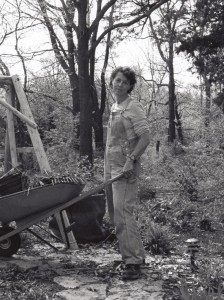
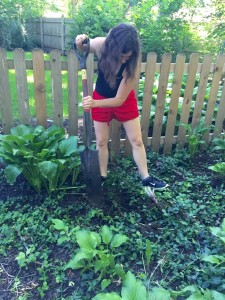
My daughter is learning how to be a farmer.  The same daughter who didn’t hide her disdain for my reaction of delight to my Mother’s Day gift of a rototiller when she was five. Emery had not been consulted, and she was not pleased. She asked me why I couldn’t want stuff like the “other” moms wanted for Mother’s Day, like jewelry or perfume or makeup.  I’m not sure if any of my mom friends wanted makeup for Mother’s Day, but I understood what she was asking me. Clad in overalls, work boots, and an embarrassing amount of dirt under my fingernails, I gave myself a sweeping gesture with the arm that wasn’t holding the shovel and asked her jokingly, “Do I look like the kind of person who would ask for makeup for a gift?” At the same time, I understood what she was saying, with her emphasis on, like the other moms. She just hadn’t seen the other moms in their more casual element. I’m sure they also had days they wore slippers to the grocery store because they were faster to put on. Without naming names, I could name one.

Out of my three children, it was Emery who spent the most time with me in my gardens. This was partly because she didn’t have a lot of say in the matter, as most of our days were spent at home, and there was always something that needed to be taken care of in the garden. Emery was the one who would follow behind me on the flagstone paths I had laid, asking me the names of the flowers and shrubs. I told her the Latin names because, after working at a garden center where we were required to use them, it had become a habit for me. I had no idea she was really listening to my answers.

While still in kindergarten, Emery referred to most of my shrubs and several of the perennials by their Latin names. This is not a typical thing for a kindergartner to do, but she had done it for so long that it became normal.  While discussing the spirea bushes, Emery would ask which ones I was referring to— the Vanhouttes or the Japonicas?  She preferred the Vanhouttes as they reminded her of a fountain with white water and thought the Japonicas (princess spirea) were “show-offs.” She was right. They were.

When Emery was in kindergarten, my flower garden became very important to her because, unbeknownst to me, my clever little girl was hatching a plan.  Her teacher, whom she loved dearly, tutored kids in the summer in areas where they needed extra help. Emery wanted more help in reading, but I think what she really wanted was more time with her teacher, whom she adored. Emery wanted their lessons to take place on the swing in the garden, because “it was the nicest view we had.”

After a few visits with Miss L, Emery began referring to my garden as the Garden of Love. She decided it would be the location for Miss L’s wedding. Miss L wasn’t dating anyone at the time, or at least that I was aware of, and when I mentioned that to Emery, she didn’t seem overly concerned; instead, she asked where the best spot would be for her to stand when the photographer came to take pictures, and did I have the phone number for the newspaper? (This was in 1996, when most people had daily delivery of the local newspaper.)  I told her under the arch, definitely under the rose-covered arch. She had sucked me right into her plan, and I was an eager participant, scheming for a bride who didn’t yet have a groom. She was specific about all the details… who to invite, what she would wear (her second decision after the location), the music and the cake, which would be the only food served at the wedding—yet still, no mention of a groom.  The only single man Emery knew was her Uncle Bill, who lived in Seattle, and at one point, she mentioned that he would probably be the groom.  Minor details.

The wedding plans faded as Emery moved into first grade, but once again, she became obsessed with her teacher,  who looked like Snow White, but who already had her prince. 

We did not have a wedding in our garden of love that summer, but several years later, I attended Miss L’s wedding with Emery. As we watched her exchange her vows, Emery looked at me, and without words, I knew exactly what she was thinking—the garden of love and the arch of roses. And yes, it would have been beautiful.

Emery’s take on the beautiful corner of the yard had me seeing it differently, whether weeding, spreading compost, planting, or simply sitting on the swing and enjoying it. It truly was a garden of love; regardless of if a wedding was taking place there or not, love was always present.

Similar seeds for a love of working the earth had been planted for me when I was about the same age Emery had been when she first took an interest in my garden. I spent a lot of time at my grandparents’ house in the summer, where my Papa spent his days gardening in his expansive garden behind their house. I marveled at the bounty he’d bring into the kitchen at the end of the day and was eager to try new foods I had never tried before, such as okra, turnips, and hominy, all of which my mom would never cook or eat. It was my Papa who showed me the magic of planting a seed in the ground, and after a little bit of work and what seemed like a very long time, it would grow into something that could be eaten. That was nothing short of a miracle for me. 

A few years later, I planted my own garden—a small, weedy patch in the back corner of our yard, where I planted a handful of watermelon seeds.  Much to my surprise, it worked, and the shiny black oval seeds grew into watermelons that looked just like the ones on the front of the seed packet. While tending my little weedy patch of a garden, I discovered a large watermelon hidden behind a tangle of vines and weeds that looked ready to be picked. I sat down, broke it open, and enjoyed the fruits of my labor. It wasn’t cold or sliced, but it was the best watermelon I had ever eaten. I ate the whole watermelon, its juice running down my chin to my chest while I buried my face in the warm pink fruit, pausing only to spit the seeds out.  Digging in the dirt was in my genes, and I’m proud to claim that it has become a part of my daughter’s genetic makeup as well.

Emery and her husband, Miles, recently purchased acreage outside of Ft Collins, Colorado, and are learning how to be permaculture farmers.  Along with chickens and bees, they will also be raising goats.  When Emery was young, we spent a lot of time at the petting farm near our house, and the goat pen was always her favorite.  She’d talk to the goats as if she were their mother—scolding, praising, and trying to teach the aggressive ones manners.  Fast forward twenty years, and Emery has found her goats again.  The same little girl who was deathly afraid of silver fish had no problem taking on a pen full of rambunctious goats, while I kept a safe distance on the other side of the gate. 
A few nights ago, Emery texted me from Taos, where she and Miles were at a workshop for permaculture farming.

“I got my spirit from you, Mom.”

I read those words, paused,  then reread them.  I didn’t want to stop reading them.  It’s beautiful to see yourself in your kids, and even more beautiful when they see themselves in you.

To you, Emery, who at one point wished for makeup, not rototillers, for me, along with manicured hands, but at the same time, insisted on spending time in my Garden of Love, because it was the best view we had. I loved sharing my love for gardening with you, but now it’s your turn.  Now I get to follow you as we walk your land, and you point out all the plants you and Miles have put into the ground, along with the many gifts Mother Nature has planted before you.  Keep digging into the rocky Colorado dirt, my beautiful girl, and you’ll find treasures that you never imagined…the biggest one being yourself.

A red coat and a gray vest.

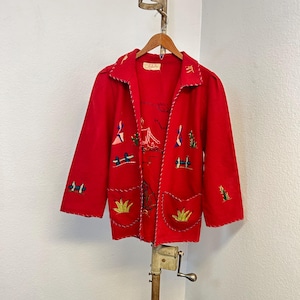
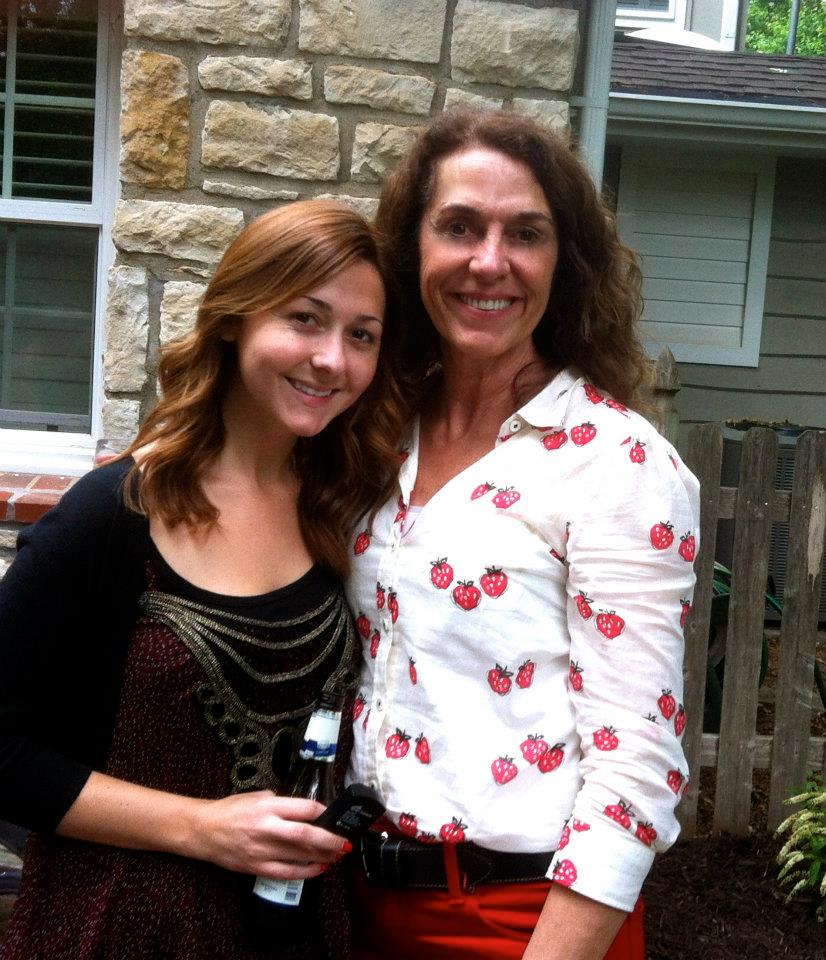
A few years ago, Emery took me to a vintage store in a nearby town that had become one of her favorites. She had been talking about it for months, but finding free time with her busy schedule wasn’t easy. She had purchased several pieces there, including clothing, her dining room chairs and some art. She told me I’d not only love the merchandise but also the store’s unique western decor, as well as the owner, whom she now knew on a first-name basis. She was right on all counts. As soon as I walked in the heavy wooden front door of the store, which sat on a corner and was once a filling station, I felt right at home. The decor in the shop matched my own decor, both the decor I own and the decor I want to own.

Emery immediately spotted a vintage Mexican tourist jacket, insisted it was “me,” and told me I needed to try it on. It was expensive, but Emery told me jackets like that were rare, especially in pristine condition. Given its uniqueness, she thought it was well-priced. Emery has talked me into buying more than one item, both clothing and otherwise, that I was reluctant to purchase because it was too expensive. But she was rarely wrong, and every piece I shared the excitement of the purchase with her has turned out to be a treasure. Swept up in her enthusiasm, I tried the jacket on. The store owner, Susan, told us it had been a rare find and she debated keeping it for herself — words that made me start justifying the price tag in my head, given Susan’s enviable style. I hung it back up and continued to shop, telling myself I needed to think about it, but knowing full well it would be going home with me.

As I made my way around the shop, weaving in and out of furniture, home decor, and clothing, a gray knitted vest that I guessed was from the 1940s caught my eye. Unfortunately, it had caught the eye of another shopper, who picked it up as I was nearing the rack, holding it up to check the size. I moved on, continuing my way around the handful of clothing racks, eventually making a full circle and returning to the gray vest, which had once again been returned to the rack. I took it to the dressing room to try on, and, of course, it fit perfectly and was priced well. Without hesitation, I took the vest to the counter and set it down, knowing it was a sure thing, but I still needed some more thinking time, or persuasion from Emery, on the jacket.

Now, if you’re still reading this and thinking, “Ok, so what?” Hold on. There’s more.

Emery continued with her persuasion, reminding me that it was so me and such a rare find, so I set it down next to the vest to buy them both.


The woman who had held up the vest previously asked,
“Did you put this here? Because I was going to buy it.”


“Yes, I did.” I figured that would clear up her confusion, although at the same time, I was beginning to feel defensive.


“But it’s mine and I am going to buy it,” she responded.


“Yours? But it was on the rack. You returned it.”


“But I was going to go back and get it, so it’s mine.”


Now I was definitely feeling defensive.


“I put it on the counter, which to me indicates that I was going to purchase it,” I said, my pulse now racing.


“But you saw me holding it up.”


“But you returned it.”


The conversation went back and forth, with both of us claiming the vest was ours to purchase, with little movement on either side. Then something shifted. I saw Emery and the store owner watching our back-and-forth and realized that, as Emery’s mom, I wanted to set a good example. Had she not been there, I would have held my ground, and things may have gotten ugly, but I would have gone home with the vest. Instead, I was the bigger person and said, “Ok, the vest is yours.”

I gestured for her to go ahead of me, and she thanked me, made her purchase, and headed for the door. Before leaving, though, she turned around and, with grace and kindness, said, “That was really nice of you, and I appreciate what you just did. Really.” And then she left. She wanted that vest, and maybe even more because I was in the process of buying it, but in that moment, it didn’t matter. I had done the right thing, or so I thought. I had set a good example in front of my daughter and the store owner, who watched the entire drama unfold. Or so I thought. After the woman left the store, leaving only the store owner, Susan, Emery, and me, Emery told me I had done a nice thing for the woman, as she looked like she was suffering. After the woman left the store and only the store owner, Susan, Emery and I remained, Emery told me it was nice what I had done for the woman as she looked like she was suffering. 


“Suffering?” I asked.
“Well, maybe. She looked sad. Maybe she had had a fight with her boyfriend or husband, or maybe she had just lost her job or learned her mom had cancer. She looked sad. And now she has the vest she wanted, and she seemed a little happier when she left.”
My first thought was that Emery saw far deeper into the woman’s emotional state than I had. As much as I liked the vintage vest, I had done the right thing, or so I thought.

“But… I can’t believe you let her buy it, Mom. I mean, it looked so cute on you, and you had it on the counter. Everyone knows that means you’re getting ready to purchase it.”


Had this been a moment of kindness I had demonstrated for Emery’s benefit, or a display of weakness?
 The store owner, Susan, chimed in.
“Yes, that was nice what you did, but clearly it was your vest.”


A few minutes later, another customer came into the store, and the store owner, whom I now also know well enough to call Susan, asked her opinion on the matter.
“Do you think that putting something on the counter by the register means you’re going to buy it?”
The woman agreed wholeheartedly with Susan (and Emery). Then, the store owner filled in the details, explaining how kind I had been by letting the woman have the vest that I had clearly claimed. Now I’m the nice, albeit pushover customer, or so it seemed. Susan said she felt bad and was going to look for similar vests on her upcoming shopping trips, and for some reason, I knew she wasn’t just saying that to placate me.

I was happy with my jacket purchase because I loved it, but I was still struggling to let go of what had happened. I wished I had been more assertive. I wanted the vest.

But there’s more…

When reviewing my credit card statement a few weeks later, I noticed a large charge from a gas station—a charge I hadn’t made. I had recently driven to KC and back and assumed the fraud had happened somewhere in western Kansas while I was getting gas, although the dates didn’t quite align. Having gone through credit card fraud a few times, I knew the drill. I called my credit card company and reported that my card appeared to have been compromised at a gas station. They credited the charge and told me a new card would arrive within a few days. A few hours later, while stopped at a stoplight, it dawned on me what the charge was for. The boutique where I had bought the vintage jacket was located in what had been a filling station, which is why the charge listed the filling station’s name instead of the boutique’s. I knew I was right as the amount was exactly what I had paid for the jacket. I called the credit card company back. First, I wanted to ensure that the merchant had been paid. Then, I asked if the charge could be put back on my card, a request they told me they had never run across before. They told me they couldn’t do that as that account had been closed. “Consider it a gift,” the woman told me. Or maybe karma, I thought.

But there’s more…

A few months later, Emery came over with a gift bag and handed it to me, explaining it was from Susan, who owned the shop where the drama had occurred. Inside was a gray vintage sweater vest, similar to the vest I had given up. She told me Susan wanted me to know it was her gift to me. I was deeply touched that she had remembered and followed through on her promise. I’m usually good with my thank-you’s, but for some reason, my plans to write her a thank-you note were forgotten. I went to the boutique a few times afterwards to thank her in person, but she was never there.

The next time I saw Susan was at Emery’s celebration of life, a day that I’ve forgotten more about than I’ve remembered. I remember her approaching me and hugging me with tears flowing down her cheeks, and the only thing I could think to say to her was, 
“I’m so sorry…I forgot to thank you for the sweater.”

She nodded, and of course, she understood.

Mother’s Day, May 2025

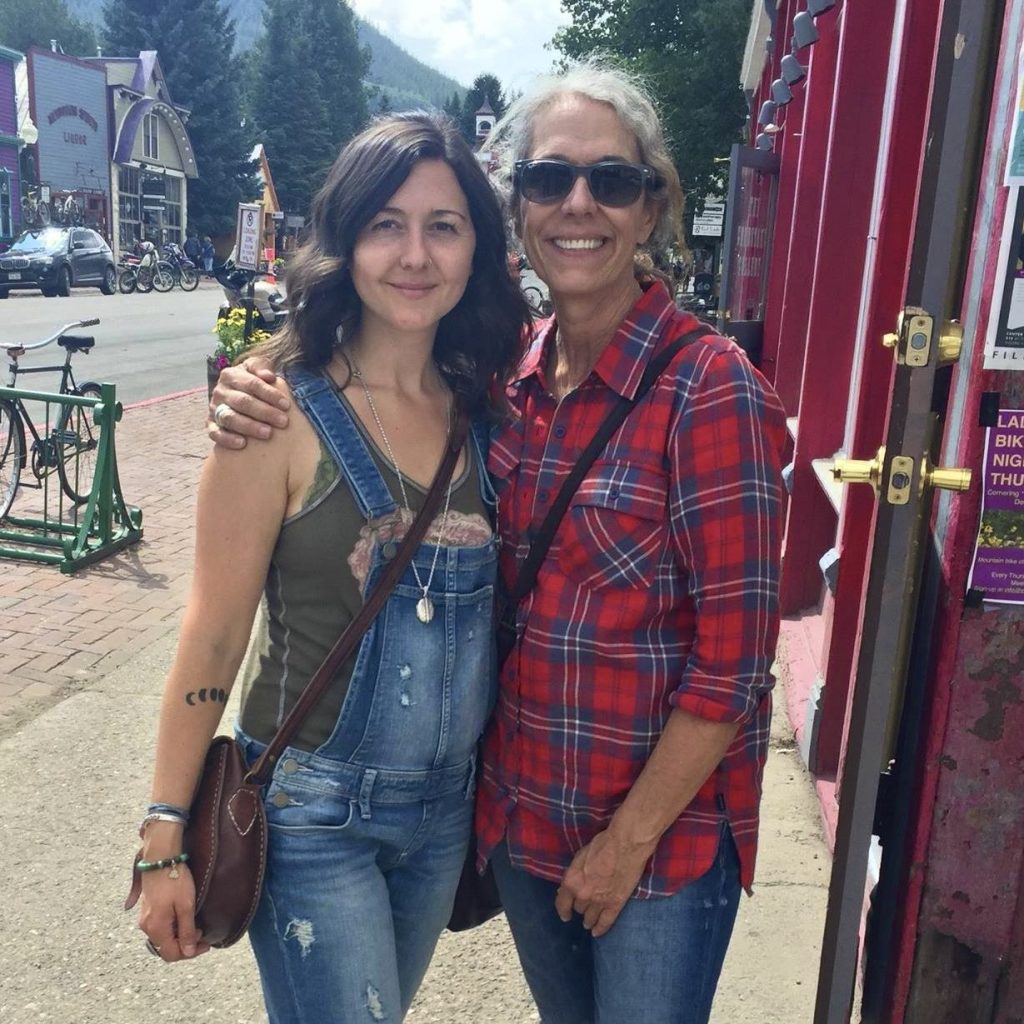
Crested Butte, Colorado, my 60th birthday

I always think of you when I hear the Fleetwood Mac song Gypsy.  For years, that song has reminded me of you, and I always picture you in your Alaska days.  Tonight, during their show, for the first time I felt myself reflecting back on my pre-Arlo days, thinking like a gypsy in spirit.  I kept thinking about how cool it would have been if you and I were able to meet when we were both in our young twenties.  I think we would have been best friends.  Thank you for gifting me with a part of your spiritual gypsy soul.  Love you always!  Emery December 3, 2018

Emery sent this email to me after a Fleetwood Mac concert, when she was living in Fort Collins and I was still in KC, but would be moving to Boulder the following summer. I liked to think about Emery and me as friends— going to concerts together and wearing vintage clothing with braids in our hair.  I held her idea, knowing that someday we would go to a Fleetwood Mac concert and pretend to be in our early 20s, instead of a young mother and grandmother. Those words hold far more value for me today, as do the conversations, the photos, the experiences, and the plans that never came to fruition, because now they carry the weight of being finite entities.

This is not the typical beginning to a Mother’s Day post for me, with musings of pop tarts on make-shift trays and kids fighting over who gets to sit next to mom. Instead, I’ve been dreading this Mother’s Day.  Emery, who is why I landed in Boulder,  and was the one who ensured I was given a proper Mother’s Day celebration, is gone.  I don’t know what to do with the day or myself, knowing that her plans for us to celebrate our roles as mamas will be painfully absent.

Last year on Mother’s Day, Emery and I celebrated our motherhood doing what we loved — we played in the dirt and planted three carloads of perennials in her front yard. Emery did what I never could on Mother’s Day. She told Miles she wanted to spend the day planting with me after our family brunch. It was her version of me wanting to go to the movies by myself for Mother’s Day, but unlike me, she asked for what she wanted and got it.   Miles took the children fishing, and Emery and I rolled up our sleeves and dug in the dirt.  We planted, we laughed, we told stories, and we cried, all with the beautiful music of Stephen Sanchez in the background.  Emery preferred the wild, untamed, and overgrown look of an English garden, whereas I preferred the orderly and tidy look of a French garden. I told her we would know exactly who planted what in three years, as her area would be a tangled mess.  She smiled at me and said, “I know, Mom…exactly like I like it.”  I told her it would be fun to see the results of our plantings on the following Mother’s Day, when much of what we planted would be beginning to show blooms.  She suggested we do the same thing the following Mother’s Day.  I agreed.  I loved the tradition we had set into motion.


We talked about travel plans — a trip to NYC, and when the children were at an age when she could leave them for a longer stretch, maybe Paris.  She said she would visit me when I returned to the house I had rented on the Oregon Coast the following year, cloudy days and all and asked me where I wanted to celebrate my 70th birthday.  Emery had planned my 50th and 60th birthday celebrations, so I knew my 70th would be no exception.  The anticipation felt good.  We had so much to look forward to.  That ended on January 4th, at 11:38 am — a time on the clock and forever in my heart that marked my before and after.  It became my line of demarcation between when my life was whole and when a big part was gone.  It marks the time from when I looked forward to the trips and plans made, to not wanting to do anything. It is my before, when joy was present and my heart felt full, and now the after,  when I can barely get out of bed in the morning, can’t sleep at night, and cry without reserve or explanation at inopportune times.  It marks the time when I knew who I was, to the time when I have no idea who I am, or who I will become in my grief of missing my darling girl.  It marks the time before, when I bought two Mother’s Day cards last year to be given on two consecutive Mother’s Days, because they were that good, to the time after,  where there will always be an unsigned Mother’s Day card in the top drawer of my desk, because I bought it for Emery, and no one else. 

Thomas and Grant, who I became a mother to before Emery was born, have mothered me since January 4th and the 48 hours that preceded that difficult day.  They held me up, gave me their shoulders to cry into, came to me from another room when they heard me sobbing, and never once told me it would be ok, because we all knew it never would be. As we were leaving Emery’s hospital room the morning she died, Thomas said, “You can’t hold your sister’s hand while the machines that were keeping her alive are turned off and walk out of the room the same person.”  He was so right. We are all changed, and our love of Emery and each other is holding us together. Through their love, I have found my respite and refuge and because they are a part of me, they are the ones who can help me carry the tremendous load of grief I have for the part of their life and mine that is missing.   They have been by my side as we navigate this unfamiliar journey that often feels like an icy precipice with limited visibility on a knife-edge cliff. They have become my strength, my comfort, and the outstretched hands in person and words over the phone that have become my stability. They are my comfort.  They are my world. They are my opening into the wisdom of how we will carry this grief and how to set it down, if only for a moment. They carry stories that only we know, that are now safeguarded for Emery and Miles’ children, Arlo and Muna. To Thomas and Grant,  I’m honored that you call me Mom on this most difficult of Mothers’ Days and every day after.  You hold my heart. 


Emery’s Dad, Charlie,  and I were with our girl for her first breath and also her last.  We linked the circle of Emery’s being in the hospital room, overcrowded with machinery, anticipation, and hope, while time slipped and stalled and ended with a painful loss, whose depth we are still grappling with. And just as Thomas would later confirm, we filed out of her room, different from the people who had entered.

I’ve been going through the files on my computer titled Emery.  In it are countless letters and essays I’ve written to or about Emery, along with emails from her. I found the words I wrote for her Celebration of Life, and next to that, a copy of her death certificate.  That last entry makes it feel like the file had been closed, but it hasn’t.  It can’t be closed just like I can’t tell people I have two children.  I have three, two of them living. In rereading the essays and letters, there is a common thread of my difficulties in letting go that started with her going to kindergarten and ended with  her getting married, and eventually, moving to Colorado.  I didn’t want to let go.  I didn’t know how.  I learned the night after getting her settled in her dorm room at college, when she called and asked if I could return to college and be her roommate, she didn’t know how to let go either.  I knew she was joking, but I also understood the sentiment behind her words.  We missed each other when we weren’t physically close.  One of the letters I found in the collection was one she wrote me for my 60th birthday.  I stopped and started it several times as it was painful to read and decided to include part of it given that it’s Mother’s Day.

August 30, 2015 (from Emery)

“You taught me to always listen to my intuition and follow my heart. I’m so glad I listened to you because I wouldn’t be who I am today if it were not for you.

This is what I’ve learned about the heart and the mother and child’s bond:

When two people are near one another, their hearts’ electromagnetic fields synchronize.  This synchronization is like a support system, one heart learning to beat with the other.  The first begins in utero, when the mother’s and baby’s hearts synchronize. When you’re away from that person, your heart goes through a period where it has to focus on beating without the other heart, and it takes some time for your heart to get back to beating on its own in a normal fashion.  This is the feeling of heartache or missing the person.  It is real.

As two people who have spent so much time together, our hearts sigh with relief when we are together, Mom,  because we are so familiar with each other.  So, when I say I love you from the bottom of my heart, I really, really mean it.  I love you so much, Mom. Emery”  

You were right, my darling girl, the feeling of heartache is real. I wonder how much time it will be before my broken heart goes back to beating in the way it beat before January 4th at 11:38, if that will ever happen.

I’ve often spoken of the umbilical cord when writing about mothering, or the metaphorical cord after the physical one has been cut.  I’ve referenced my umbilical cord stretching itself to three different parts of the country, where my three children lived.  I don’t know how far Emery’s cord stretches now, but I know it’s still there. I can feel its tug when I see Muna’s big brown eyes and soft curls, so much like her Mama, or when Arlo leaned in at our birthday dinner, wanting me to tell him stories about his Mama.  I will tell him all the stories I can remember, and story by story, word by word, he and Muna will have the tools to paint a picture of their Mama when she was a child.   I feel the cord wrapping itself around my own heart, which is no longer intact, yet, the connections continue —a red-tailed hawk circling overhead, a quarter found on the floor next to my bed with 1990 on it, and a framed photo also near my bed that randomly fell over yesterday. Connections are different, but present. 

I used to tell my kids that I would stand before a moving train if I had to to protect them.  I spoke metaphorically, but the deeper I got into motherhood, the less metaphorical that statement became.  I’m sorry I couldn’t stop that train on Jan 4th, Emery. I couldn’t even find the tracks, and as a mother, not being able to come to your rescue has been so painful that I sometimes struggle to find my breath. 

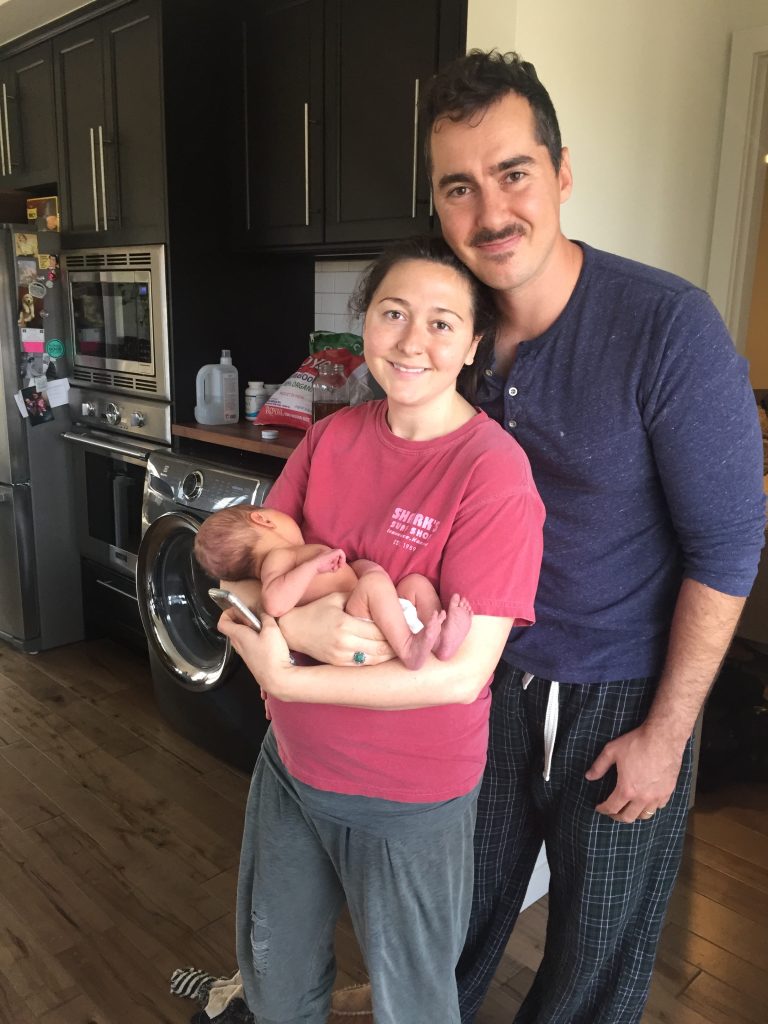
My Mother’s Day post in 2017 was dedicated to Emery as she had just given birth to her son, Arlo, four days earlier, ironically, on my firstborn, Thomas’s, birthday.

It feel timely to include an excerpt from that post.

Mother’s Day, May 4th, 2017

I will always be your mother, and you will always be my daughter, but now we’re entering into a new place, given that we both are mothers now, and that in and of itself is just about the most beautiful and perfect thing I can think of on this very first Mother’s Day for you. 

You will have days that you feel like you are swimming upstream in mud, and it will be hard to maneuver yourself out of the mire, but you’ll figure it out, and before you begin to slump into a human question mark, rest assured, dry land is never out of sight.  You’ll stumble, you’ll fumble, you’ll eat a bag of chips with a salsa chaser for breakfast, and you’ll call pajamas clothes for more days than you care to admit, and to that I say “do it.”  And do it repeatedly because you deserve every morsel of not-so-healthy and every hour of long past time to get out of your jammies.  You’re a mama now.  Claim that right with pride.

You grew up with a mom who often felt like that frazzled, wild-haired bus driver in the Magic School Bus series, which I greeted at the time with a sigh and a promise to myself to get it right the next time. Still, decades later and without apologies, I realize that the messy, the dirty, the not wearing the right shoes, or shoes at all, and letting go of a whole lot of shoulds and coulds, just might have been one of the best gifts I could give you.  I can’t end this letter without a big shout-out to your partner in life and love, Miles.  His hands-on fathering melts my heart. What a lucky baby Arlo is to have you both as parents.

From one mother to another, I wish you the best of everything and several consecutive hours of sleep this Mother’s Day, dear Emery.  Only now that you are a Mom, can you begin to understand how much I love you. And I do.  So much.

Still.

To all reading this, celebrate your role as a Mom, or celebrate your Mom today.  It matters deeply.

Mother’s Day, 2012

The moments that your heart holds tight….

It’s the small things in life that seem to hold the most real estate in my heart – not from birthdays or weddings or special holidays, but rather, the moments from every day life that surprise me and have me wanting to push the pause button and absorb it before it moves past.   I had one of those moments on my last morning in Colorado, while staying with my daughter, son-in-law and 10 month-old grandson.

I was sitting on an ottoman that I had pushed up in front of the windowed door to the deck with my grandson,  Arlo, on my lap.  It was early morning and the sun was still making it’s last climb over the horizon, leaving a soft yellow glow in the house; that very peaceful time of day when everything seems to move a bit slower, including 10 month-old babies.  A herd of 20 or so mule deer were slowly making their way across their land, close enough to the house that they were easily spotted by both of us, even though their coats were camouflaged against the color of the winter grass.  When Arlo spotted them, he quickly looked up to me to insure that I also saw them, then pointed his small finger at them,  looked up at me again and smiled.  Arlo is a very busy, very mobile baby, so the  moments seemed borrowed in a way and I held onto them as long as I could as I knew while it was happening that it was a moment and a feeling  I’d later savor.

We sat there  for several minutes, quietly watching as the deer slowly made their way across the land behind the house, Arlo’s eyes wide with fascination. When he had seen enough, he turned his attention towards me and  grabbed my necklace, as he often does because he’s a baby and that’s what babies do, but this time he held it in his small hand as if he was really examining it, rather than simply trying to pull it off of my neck.  It’s a small silver disc with  the words “protect this woman” surrounding a small turquoise piece in the center.  I’ve worn it continually  around my neck for the past 5 years.  He seemed very curious about it.  Someday, Arlo, I will tell you about the day that I found the necklace in a small shop in Leadville, CO.  I will tell you that in the previous months, I had climbed to the top of five 14,000 foot peaks, by myself, and although I have a weakness for silver and turquoise, it was the words on that small disc that had me buying it without hesitation.  I’ll explain how even though it is only a piece of jewelry that I wear around my neck, somehow, it makes me feel just a tiny bit safer.  I’ll show you, someday, what it felt like to climb those five tall peaks and will give you the handful of tips I discovered  as we climb them together.

I will also tell you about the first morning after my young family had moved into our new home,  when your Mom was not even three,  and I saw a huge buck circling the large cedar tree in the front of our house and how mesmerized I was by the site of him and the fact that there he was, right in our own front yard. There’s just something about watching deer so close to where you live in the early morning hours.   I’ll tell you that those 5 acres that surrounded our new home made me feel like I was living on a ranch as I had never lived in a place with so much land around me.  You’ll laugh about that one, no doubt, as living with a lot of land around you is all you have known, but that’s ok.    At some point, I’ll  tell you the rest of my deer story… the part where the deer could wipe out days of work in my garden during their early morning feedings and how I spent countless hours and endless experimentation trying to deter them.  Even so, that morning when I saw the buck circling the cedar tree, just feet from our front porch, still wins on the deer memories for me.  Did I mention that it was snowing lightly that morning?

As I sat there in the quiet house, with Arlo  on my lap, I felt the awe of the role of Grandma that I was blessed with a short 10 months ago.  It’s a role that I covet dearly, first, because I am a mom and to see my baby take on the very role that shaped the biggest part of my life is beyond miraculous to me.  Second, because of my own grandparents and the important role they all played in me becoming who I am today.  My love of knitting, sewing, gardening, photography, writing and love of travel were all introduced to me by my grandparents, whether directly with a hand reaching over mine as I held a red plastic knitting needle as it formed stitches or indirectly, simply by exposure.

The silver bangle that I’ve worn on my right wrist since I was 16, is one of many continual reminders of their influence  in my life.  I can remember my maternal grandmother, always with an armful of silver bangles, and the noise she would make when she entered a room.  Her granddaughters were each given one of her bangles when she died and I’ve carried that little bit of her on my wrist ever since.  There are other reminders that come in flashes – the first bloom of the iris in the spring, a well-written, witty letter, a bolt of fabric with its limitless possibilities when a sewing machine and a lot of patience are added, skeins of yarn and needles and the hope of sweaters that will fit and the ever present  camera that resulted in boxes and boxes of  beautifully captured photographs.  These are the pieces of my life that have given me my sense of passion and have pushed my creativity in ways that continue to challenge me. If I can contribute in  a similar way to my own grandson’s life, I will feel like I’m not only sharing some of who I am with him, but I’m giving thanks to my own grandparents in the process.

Last week, I was in a baby store shopping with someone who I’ve called my best friend since I was 15 years old.  She was shopping for her  6 week-old grand son, and I was shopping for Arlo.  We hadn’t been there long when it hit me and in between the oohs and ahhhs and is this cute?  too cute?  and how big will he be in 6 months?,  I stopped,  pondered the reality of the moment, and commented.

“Look at us….friends for 3/4 of our lives, you living on the east coast for most of it,  and me in the midwest,  and here we are, in a baby shop in Breckenridge, Colorado, shopping for our grandsons.  Could you even have begun to imagine that out of all the searches we made together… the clothes,  the parties, the guys, the fun the beer and the cheap clothes and babysitting jobs to pay for those cheap clothes and maybe someone with a fake ID to buy the cheap beer, that someday our search together would be for baby clothes… for our grandsons???”

A beautiful passage of time seemed to have had us both in its collective hug and the 46 years had brought us to a moment that I think caught us both off guard.  We became grandmas for the first time 9 months apart and after sharing so many firsts, we’re sharing one again.

So, Arlo, that moment we watched the deer with the sun rising at our backs, tucked away in the quiet of the house  with you seated on my lap,  was one moment of countless moments to come.  I have so much to tell you and share with you and if just one of those many moments impacts you enough that someday you’re sharing it with your own child or grandchild, or really anyone, then I will have succeeded and that yarn of all of our collective experiences will continue to knit the stories that will connect the generations.   We  are all a part of the creation of something quite beautiful – stitch by stitch, row by row, that continues to grow.

Thanksgiving 2024

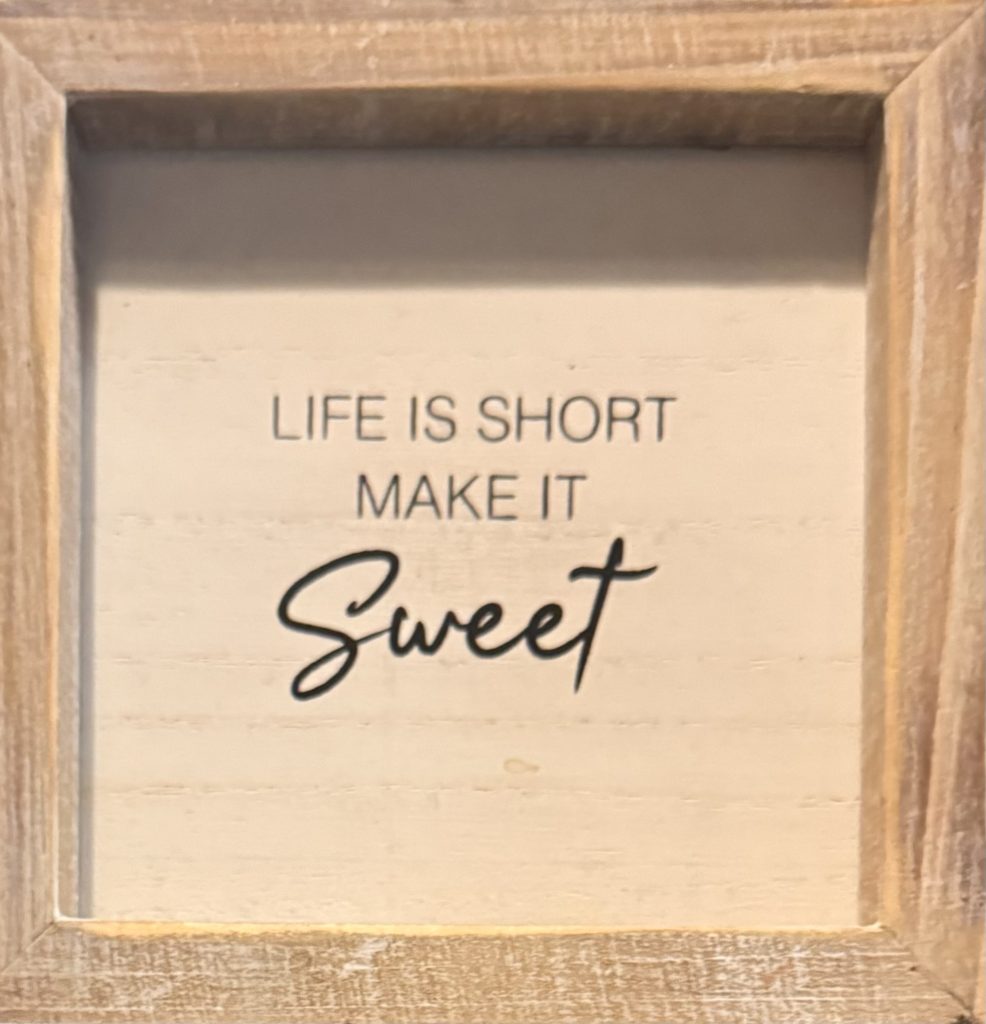
Life is short.  Make it sweet.  These words were printed on a wooden block that fell off a shelf and landed inches from my feet as I filled my coffee cup at McClain’s Bakery in Kansas City.   I picked up the wooden block just as one of the employees came over with profuse apologies and returned the block to the shelf next to the coffee urns.

I took my coffee to a nearby table and opened my computer to work on some writing, but I couldn’t stop thinking about the falling block and its message.  It felt like a tap on the shoulder that I couldn’t ignore.  Life is short.  Make it sweet. It also felt like something Dad would have noticed, possibly adding that he could have made a better block with letters carved instead of painted. It’s also possible that Dad was trying to bring those words to my attention with a block that was not precariously perched but fell anyway and landed at my feet.  There have been so many incidents since Dad passed, starting with the red-tailed hawk, where his presence was undeniably felt.  I’m counting the falling block as another one.

In the past several months, I’ve experienced the highest of highs and lows that had me crumpling and wondering if I’d ever be upright again. In July, my granddaughter, Frankie, entered the world, exploding my already full heart. The next month, my sister, Robin, was diagnosed with Stage 4 pancreatic cancer, and a month later, my dad died—a timeline of the highest of highs and the lowest of lows. My cousin, sensing the profound grief and sadness I was experiencing, told me to look for the sparkles every day, especially now, as they will become more important than ever. I decided to follow her advice. During Dad’s short stay in hospice,  I sat by his bedside for several hours and let my mind weave its way through countless memories, some bringing tears to my eyes and others a good laugh.  Because the hospice nurse told me even though he might not react, he could hear me, so some of those memories I shared aloud with him. The door to Dad’s room was open, and during a quiet moment, a woman, who I didn’t know, came in, walked over to me, leaned down, and hugged me.  I was surprised, confused, and comforted.  She told me she hoped it was Ok, and I nodded, not knowing what to say; then she added, “I sat with my dad a month ago, and I know the feeling.  I recognized the look on your face when I walked by, and it looked like you needed a hug.”  I thanked her, told her she was right, and then she was gone.  It was all so fast that it took me a minute to absorb what had happened and the gift I had been given from a complete stranger.  Life is short. Make it sweet. I was grateful for my cousin’s reminder, and since then, not a day has gone by that I’ve not seen a sparkle.  The block falling at my feet was an unexpected but very welcomed sparkle.

I’ve been through the lowest of lows these past few months, but it was in those lows that I’ve been reminded of what really matters, even though it was something I knew all along. Thanksgiving is about toasting and giving thanks at a beautiful table filled with platters of food and the cranberries I insist on bringing, even though my daughter tells me nobody likes cranberries.  And just like last year, I will bring home an almost full dish of cranberries that I will eat for a few days and then throw away. Thankfulness is the incredible group of people from around the world who I met while at a writing retreat in Greece last July and who I now call my friends.  Thankfulness was the birth of baby Frankie, who arrived days before I left for Greece and who became my priority when I got home, booking my flight to LA two days later to hold her in my arms. Thankfulness is the moment when I set down the burden of heavy anxiety I had been carrying with an exhale and a sigh of relief because the doctors said Robin’s bloodwork looked good and her cancer was asleep. Thankful is knowing Dad had an easy and peaceful passing, confirmed by the hospice nurse who, in her compassionate delivery, told me he had a perfect death — quick, painless, and peaceful.   

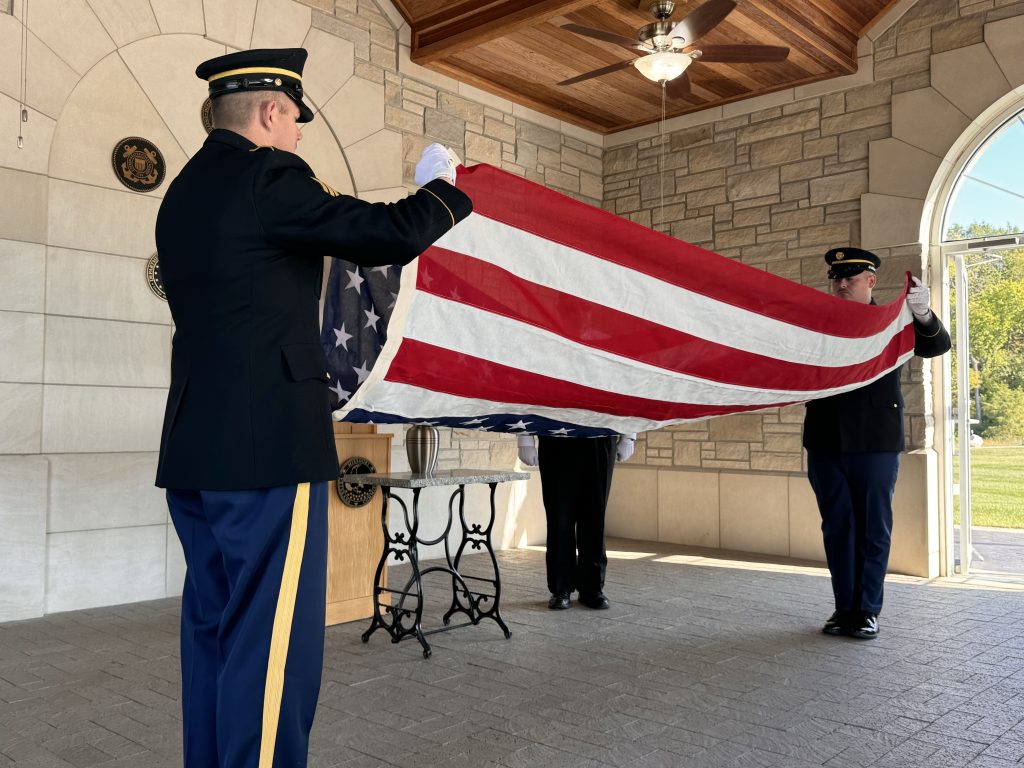
I’m thankful for the love my kids have given me with their emotional and physical support and for showing me through grief and sadness that family and friends are what hold us together in life more than anything else.  Family. Friends. Cousins. My Mom. We’ve all been holding each other up and, in doing so, have found our strength, our resiliency, and, thank goodness, our humor.  A comparison between poorly folded sheets in the linen closet to the flag the two soldiers ceremoniously folded at Dad’s military ceremony was some of that necessary humor.  

I’m thankful for unexpected reminders that life really is short and to make it sweet.  In a time when life has felt so difficult and I wondered what I could find to be thankful for this year, I’ve come up with a list that holds more meaning and depth than most years, which I’m calling my Thanksgiving sparkle.  

Happy Thanksgiving to anyone who reads these pages.  I hope your day is filled with unexpected sparkles with people you love and cranberries that no one likes but someone made because they love you.

Continuing Tradition with 24 Beats

Dad started what would become a tradition when he and Mom moved to their retirement home 15 years ago.  I don’t remember if it was Veterans Day, Memorial Day, or the 4th of July, but on the first patriotic holiday after moving in, Dad went to their patio and played taps.   He told me he didn’t know if anyone else could hear it (adding that most had compromised hearing, so probably not), but even so, he felt it needed to be played to honor and respect the many Veterans who had died.  His playing was noticed, and so it continued and soon became his tradition.

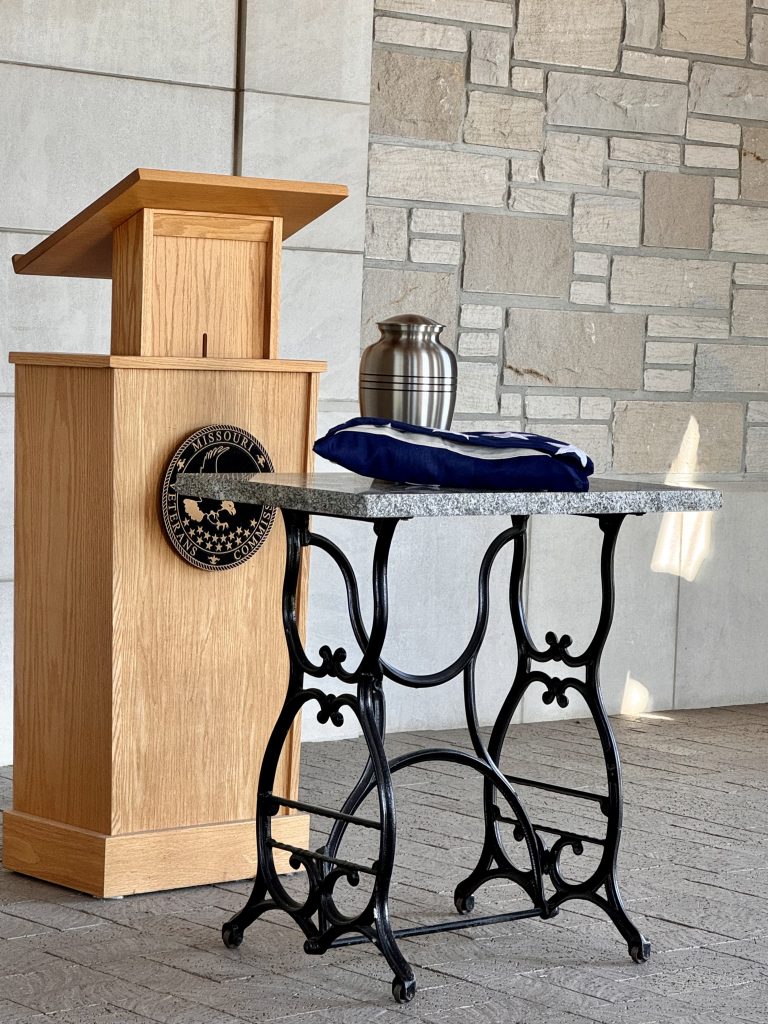
When our family was at Dad’s interment ceremony at the Veteran’s Cemetery in Higginsville, Missouri a few weeks ago, the ceremony began in a small chapel. I transported Dad’s ashes again, although this time in the back seat of my car as Mom was riding shotgun. When we arrived, the urn of ashes were placed on a small table in the front of the chapel with the tricorn folded flag in front of it.  Two uniformed service members unfolded the flag and with ceremonial respect and measured precision, refolded it before handing it to our mom.  A lone bugler, who was positioned outside the chapel,  played taps as the flag was being folded. I was Ok, or as Ok as one is when their father dies, until I heard the sound of taps being played.  I thought about the many patriotic holidays when Dad played taps, whether anyone could hear it or not. Today, with the urn of his ashes on the table while two uniformed servicemen refolded the flag, I realized the significance of an unknown bugler playing for a man they had never met – the same man who never let a patriotic holiday go by without playing taps on his patio for the soldiers he knew and most that he never would.  Someone was playing taps for Dad. With that realization, my tears flowed. Dad would have loved the precision of the military ceremony and the respect paid to him, but most of all, he would have loved the sound of the bugle being played in his honor and having his family present to witness.

Taps is a 24-note melancholy piece of music played by a single instrument, usually a bugle or a trumpet.  It began as a last call before lights out that was played on military bases. It eventually evolved into the familiar solemn farewell that few can hear without being emotionally touched. It is played slowly, respectively, and never with embellishments. 

I miss you, Dad, especially on days that held such deep meaning to you.  It took me hearing taps at your funeral to understand why playing the 24-note piece became not only your honor to those who lost their lives in service, but your personal obligation. Today, on Veteran’s Day, I have no doubt that someone will play it for you, in your honor.

Unexpected moments.

Two different versions of pensive…

When I got in the car after carefully placing the cargo in the front seat, I texted my siblings and told them Dad was riding shotgun and I was on my way back to Mom’s.  I hesitated before sending it, wondering if it was inappropriate or possibly disrespectful, but then realized it was exactly what Dad would have said had his dad been riding in the passenger seat in an urn that sat in a box, placed in another box in the front seat.  Because Dad was a veteran and will have his ashes interned at a military cemetery, his ashes were accompanied by a flag given to me at the funeral home, appropriately folded into the symbolic tricorn shape with no red or white stripe showing, only the blue field with stars. Picking up his ashes in a Kansas City suburb at least 30 minutes away without traffic was a task on a list of things that had to be tended to and one I said I would do as I had a free morning.  I’m glad I agreed to what now felt like an honor despite the rush hour traffic I had to go through to get there. When I glanced over to the passenger seat and saw the box with the tightly folded flag sitting on top of it, I knew it would be a moment I would recall later and more than likely write about because it was a new experience for me because it was my Dad, or his remains, as the funeral home now referred to him, who would make this a story and not just something to check off in a long list of things that needed to be tended to.

When we made our initial trip to the funeral home to sign papers and go over details after Dad passed, my brother, Tom, in preparation for being the one to pick up the ashes, asked if the urn had a screw-off lid; we had been seated around a dining room table in a room that looked like it had been decorated to make families feel at home.  Except for the display of jewelry that could be purchased with your loved ones’s fingerprints in the center of the table, it felt like an informal gathering around a dining room table. I don’t recall the woman’s title who we were meeting, possibly the owner, but she took her place at the head of the table after helping Mom into her seat and pouring water for everyone.  Once seated, she smiled at my brother and said he was not the first to ask the question.

“Yes, the urn has a screw top lid, and the ashes are in a bag.  The urn is then placed in a box, and that box is placed in another box. No need to worry about ashes ending up on your front seat.”

I appreciated the break of solemness with the dose of reality.  The subject was difficult, and I was learning the importance of finding the humor and breaking out in laughter as often as possible. At this point, it felt not only good, but necessary for the soul.

It wasn’t my first time transporting ashes.  Several years ago, the container of ashes of our yellow lab, Marley, rode in my lap when our family took them to our farm to scatter.  I remember thinking the container was heavier than I thought it would be, even though Marley’s weight was down considerably when we had him euthanized.  Unlike Marley, Dad’s ashes will not be scattered but will remain in the urn and be interred at a military cemetery.  I couldn’t help but glance over to the box, which didn’t look the least bit out of place as boxes often rode shotgun in my car en route to the post office to return something, but never with a flag on top.  I turned off the music in my car because I wanted to talk to myself or, if I’m being honest, maybe to the box and the spirit that filled my car. I knew the box only contained the ashes of Dad’s body and not his spirit, but it gave me the same feeling as talking to the headstones of my grandparents when I used to go with Mom and Dad on Memorial Day to lay flowers on their graves.  On one such trip, Dad had no blooms available for cutting in his garden, so he stopped at a convenience store and picked up a small bundle of plastic flowers.  When he put them on Grandma and Papa’s graves, he added a note that said, “Sorry about the flowers, Dad, it was the best I could do.”  His dad raised hybrid irises as a hobby, so he knew flowers well, and the apology was appropriate. Conversations graveside on Memorial Day were not solemn for Dad but rather practical.  I followed that lead while conversing down Blue Ridge Boulevard with the box of my dad’s remains riding shotgun and I was smiling for most of the journey. Afterall, I got my humor from my Dad.

I was blessed to have Dad for the entire 69 years of my life, and I’ve seen most of my friends go through this process some decades ago. I had to wonder if they felt the confusion I did right now of grappling with the fact that my physical dad was gone.  Forever.  I will always carry him inside of me — his humor, his smile, his generosity, and the way he viewed life, but never being able to call him on the phone and follow his sometimes indirect storytelling path is hard for me to wrap my head around.   His cell phone has been deleted from his T-Mobile account, and I went through his phone beforehand to make sure he didn’t have any unanswered messages and to check his contact list to make sure everyone had been told about his passing. Still, I can’t take his number out of my phone.  And I’m struggling with using the past tense when speaking of him.  I wonder… do these issues fade in time?  Become more natural?  More comfortable? More familiar?

Dad was 96 and had a very good life for 95 and 3/4 years, and that is what I keep reminding myself.  A few days after Dad passed, my sister, Susan, and I went to our usual coffee spot near our sister Robin’s house in an urban setting of Kansas City.  Exiting the car, we saw a red-tailed hawk perched on a fence post.  As hikers, we both were familiar with the bird of prey, but not in an urban setting.  Susan looked at me, and I looked at her, and we both nodded.  Dad.  After an hour in the coffee shop, we returned to the parking lot, where the hawk was still sitting on the post.  This time, there was no question.  Dad.  I later read that “the sudden appearance of a hawk may indicate a loved one who recently passed is sending signs through this spirit animal about their continued presence.

We both felt a sense of comfort and reassurance.  A few days later, I felt the same sense of comfort while I looked over to the box that occupied my passenger seat at a stop light and smiled.  You’re still with me, Pops, and I feel your presence. The tightly sealed urn wrapped in bubble wrap in a box that’s in another box with your ashes in it is as close as I’ll ever be to you again physically, but you’ve taught me to be curious and question things that don’t make sense and if you believe something, to trust that belief.  I believe you gave Susan and me a nudge with the red-tailed hawk.

I know that processing Dad being forever gone will come in spurts and not always at the most opportune times.  In the days leading up to Dad’s death and the weeks that followed, the only people I saw were family, nursing staff, hospice care staff, attorneys, bank employees, and the woman who explained the packaging of the ashes at the funeral home.  I’ve been immersed in a place I didn’t anticipate being in on a visit to my hometown to see my sister, Robin, who was recently given the terrible and hard-to-process diagnosis of pancreatic cancer. This process has exhausted me to my core, and I’ve cried more in September than possibly in the entire of my life, yet here I am, still upright, with memories crowding my mind, each one vying for attention.  I worry about Robin while in the throes of mourning my father’s death.

I keep circling back to a letter Dad wrote and tucked into my suitcase when I left for college. He typed his letters as his handwriting was difficult to read, always with the oversized “LOVE, DAD” scrawled across the bottom of the page.  He said, “This could have been considered the 8th wonder because it is not like me to write letters, except possibly to tell some unsuspecting parent that their child wasn’t graduating.” You didn’t know when you typed that letter, Dad, that it would become one of my most cherished letters and give me the idea to do the same with my children.  My kids all got letters that I tucked under their pillows after making their beds in their dorm rooms, something I insisted on doing simply for the letter placement.

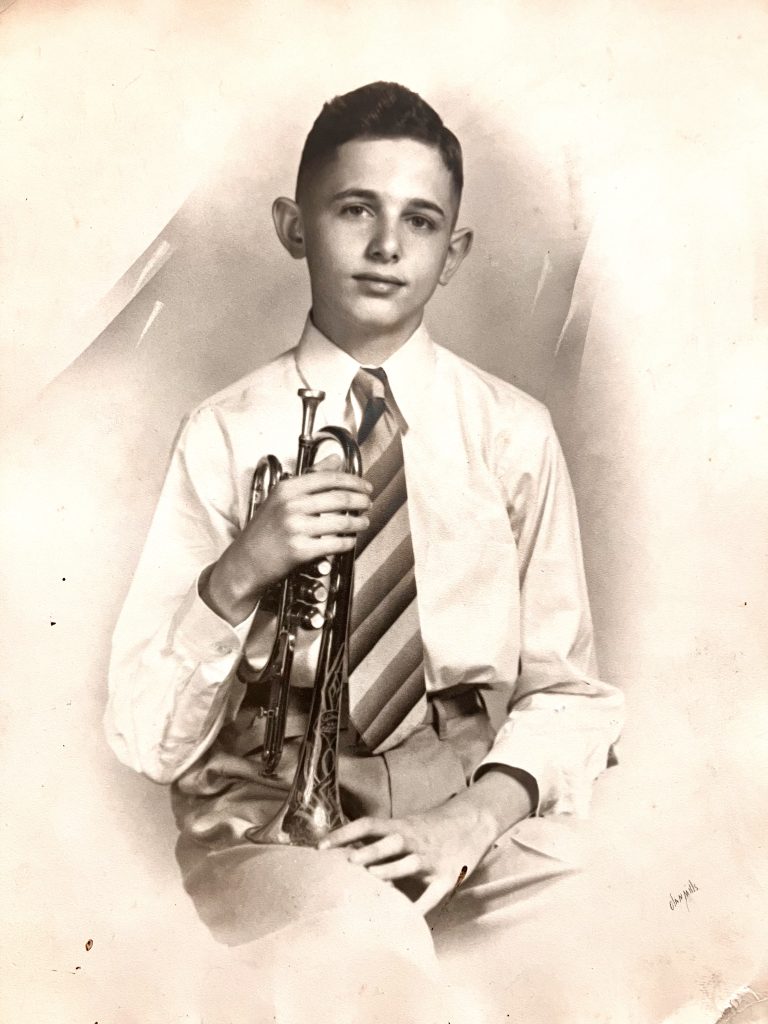
“There were times, Laur, when I could have knocked you on your ear, but believe it or not, it was always out of love,” the letter continued.  Several months ago,  Dad had been admitted into the hospital due to issues with his pacemaker and, within 24 hours, was diagnosed with pneumonia complicated by COPD, followed by being intubated, a very dangerous procedure for a 95-year-old.  Two days later, and with much surprise to the doctors, they were able to remove the intubation, and Dad began breathing on his own.  I saw him that day, early morning, and it was just the two of us in the room.  Maybe it was his near brush with death at that time, or maybe I just caught him at the right moment, but we had one of the best conversations we had ever had despite his difficulty in talking.   He told me I was a “real pain in high school, which was a very challenging time…for both of us.” Those words made me smile, and I couldn’t disagree with them because Dad was right.  Then he added that he parented me the same way his dad parented him, which meant ignoring a lot of the behavior and letting me be who I needed to be in the same way his dad had done with him. It was honest.  It was real.  He added that he thought his dad knew he was sneaking out of his bedroom on Saturday nights while in high school and hitchhiking to downtown Kansas City, where he was given playing time with the jazz band The Scamps.  I felt more connected to him in that moment than I ever have—his rebellious spirit clearly having made its way into me, although my stories paled in comparison to his.

The letter ended with, “I’m sure I’ll continue to get upset sometimes with you, but I love you so much and always want the best for you.  And no matter the struggles, you will be OK.” 8/20/73

9/26/2024. Thanks, Dad, for writing those words to me that I read alone in my dorm room, and now, 51 years later, I’m reading again, alone in my living room. I’m holding onto the “you’ll be OK” part with everything I have right now.

Writing Dad’s Obituary

I’ve written things I didn’t want to write, pieces I regret ever seeing the light of day, and countless stories, essays, blog posts, and a few memoirs that may never be finished.  Some pages come easily; others are slogs, but I stay with it if I feel like something’s there.  A few days ago, I was given the difficult task and deep honor of writing my Dad’s obituary.  I  was honored my family gave me the responsibility of writing it, but I also struggled.  Not because I couldn’t find the words or the stories but because I didn’t want to write in past tense.  It was also hard to edit my words to an appropriate-sized piece as I wanted to include far more than would fit into the parameters of an obituary. I called the Kansas City Star to ask them what the average length of an obituary was and was told there was no limit.  She told me they had seen a few at 900 words, which was rare, and if I had a lot to say, 800 words was a good number.  As we spoke, I looked down at my word count.  982.  OK, I told her I’m good.  Inhale, exhale, and start deleting. 

I settled into a table at the back of a cafe with a big cup of coffee and my computer and started typing. I was only a few sentences in when I realized that typing in a public place had not been a good idea, as I was only a few sentences in when I began to sob.  If anyone around me knew what I was typing, I’m sure they would have stopped staring and sent over some tissues. After an hour or so, or about a large cup of coffee later, I finished editing, cutting a few hundred words in the process. The cutting felt painful because who am I to decide what is put in and what is left out when it comes to such a public reckoning of who my Dad was and what he did in his life?  Dad was a storyteller.  He would have also struggled with the assignment.  I felt proud and sad at the same time and made a promise to myself that it wouldn’t be the last time I wrote a piece about my Dad.  I was also sad, because Dad was one of my favorite readers, always with a comment, and this would be one piece he would never read.

Dad was blessed with 96 years, and up until two months ago when he fell, most of those 96 years had been good, with Dad holding onto his attitude of “today is going to be my best day yet,” regardless of what he had on the calendar. 

 I left the cafe with the kind of headache you get after crying, a pain that is felt more emotionally than physically. I got into my car, called my sons who happened to be in town and told them I was on my way to meet them for lunch, then I backed into a truck who was entering the parking lot.  I’m a good driver and can count on one hand how many wrecks I’ve been in with a couple of fingers left over, none of them serious. All I could think of was, seriously?  This is how I’m ending my morning? The couple exited the truck, and the man said, “Oh great, I see you don’t even live here… Colorado?”  “Yes, I do, but I’m here for a while because”… I considered my next sentence as it felt manipulative, but I said it anyway… “My Dad passed last week, and I’ll be in town for a while.”  The woman sighed and told me how sorry she was.  The man went back to his truck in search of paper. Both of our vehicles were damaged, his worse than mine, but both were drivable. We exchanged information, and I got back into my car and cried because I wasn’t sure what else to do, then started laughing because seriously, had I shared with the couple that I had been in the cafe writing his obituary…well, you can’t make this stuff up and it sounded like I just did. 

The events of the morning would have been a great story to share with Dad.  After hearing it,  he would have ensured that I was OK and the person I hit was OK, then would have found the humor in the situation along with the irony.  He was good at that.  Had he been in a similar situation, he would have chatted with the other driver and likely shared a story, ending with a handshake and a laugh. You were the storyteller, Pops, and I was honored to be given the gift to tell yours. 

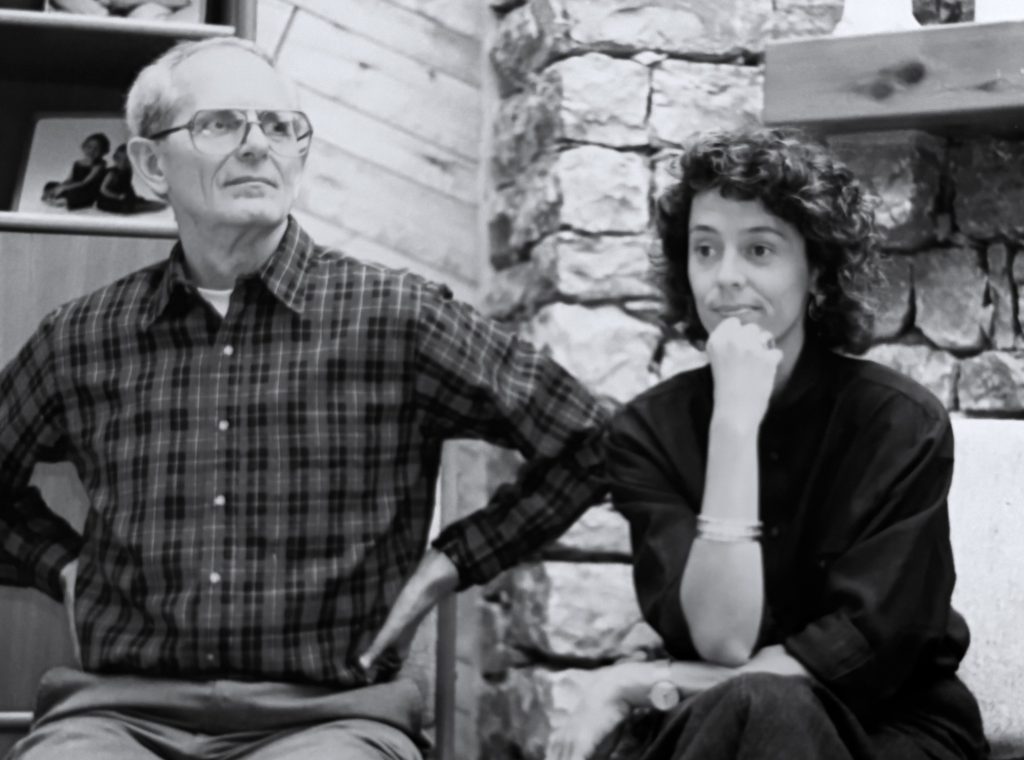
Bob was often called a Renaissance man, “a fully-rounded person, knowledgeable in many areas, including the sciences, arts, and humanities.”  To that, his family would add that he was the one who got the call when the car wouldn’t start, the disposal was jammed, or help was needed to get an oversized mattress down a narrow flight of stairs. Dad was the first call when a trusted Volkswagen was no longer trusted and needed a tow. He improvised with his equipment more than once by taking his belt out of the loops and using it as the tow rope.  Dad was always available and ready to roll up his sleeves and go to work whenever his family needed him.  This philosophy was also how he spent 28 years working Monday through Friday at Olathe High School, where he was a guidance counselor with an open-door policy to anyone who needed advice, encouragement, counsel, or simply someone to talk to.

Bob was born in Pleasant Hill, Missouri, on August 1, 1928.  He died on September 7, at Foxwood Springs in Raymore, Missouri, where he and his wife Nancy had lived for the past13years.  When Bob graduated from high school, he joined the Army and was stationed in Pisa, Italy.  His musical ability was recognized, and he was asked to form a band with the German prisoners of war.  He didn’t speak German (or Italian), but he shared the language of music with his band, communicating with notes, not words. 

He met his wife, Nancy, at Central Missouri State University in Warrensburg, Missouri. They were married after he graduated, and on August 29th, they celebrated their 71st anniversary.  He had a special evening planned 71 years ago that would end with a marriage proposal, but he couldn’t wait. Bob pulled off the highway under a Miller High Life billboard and popped the question.  Nancy said yes, and on every anniversary after, including this last one, he would tell anyone around that he still couldn’t believe she said yes. 

Bob and Nancy had four children: Robin Blackman of Kansas City, Missouri  (Jim Cumley), Laurie Sunderland of Boulder, Colorado, Susan Ketterman of South Egremont, Massachusetts (John Clarke), and Tom Blackman of Olathe (Renee Barta). They also have five grandchildren: Thomas Sunderland, Grant Sunderland, Emery Golson, Randi Jo Blackman, and Evan Blackman, as well as five great-grandchildren.

Bob was a curious man with many hobbies, most of them worked on in the garage, which never had a car parked inside. Instead, it became the headquarters for Bob’s many creations, which included everything from making furniture to carving intricate designs and figures to building a telescope that he spent countless hours working on in an unheated garage.  His biggest project was building a sailboat. The maiden voyage was at a nearby lake, and before pushing the newly crafted boat into the water, he announced that he had no idea if the boat would float or sink. Thankfully, the boat didn’t sink and became another weekend hobby.  

He taught his children, his students, and anyone who knew him the power of kindness and the beauty of living with a “glass half-full” attitude.  At age 90, he connected with a few musicians at his retirement facility and formed a jazz band where he played the coronet.  Playing music was one of his greatest passions, and even at age 96, he still played with strength and soul, never using sheet music, always by ear.  His last concert was ten days before he died.  His love of jazz began in high school when he would sneak out of his house and hitchhike to jazz clubs in Kansas City, where he was given opportunities to take the stage, eventually playing with the band The Scamps.  Expressing himself through notes played on his horn was one of his greatest joys, and although they wouldn’t let him play his coronet in rehab, his mouthpiece was on the table next to his bed.  One of the nurses said they weren’t crazy about him using the mouthpiece due to breathing issues, but they weren’t about to take it away from him as it gave him so much joy.  Two days before his passing, when he was beginning to fade, a video was shared of him playing a solo during a recent concert.  His eyes were closed, but he had a big smile on his face, and his foot began to mark time under the blankets. When asked if he knew who it was playing, he shook his head and said,  “No, but he sure is good.”  You got that right.  You sure were good.  

His kindness, his smile, and his “today is going to be my best day” attitude will be forever missed.  

MY PAPA’S NATIONAL GEOGRAPHICS

This isn’t my typical post, but it is the perfect 10 year anniversary gift to myself.

@TheKeepthings published my piece about my Papa, who was a life long collector of National Geographics. He bound and hand lettered hundreds of issues, including Volume One, Number One, into books. @TheKeepthings is a memoir project where people share stories of lost loved ones and the things they left behind. It’s filled with beautiful stories that I’d encourage everyone to read. I feel honored to be a part of this project.

https://thekeepthings.substack.com/p/my-papas-national-geographics?utm_source=substack&utm_medium=email&utm_content=share

They Don’t Live Here Anymore

Looking into the memories of an empty room.

There’s a saying about not being able to go back or return home or something along those lines — my own interpretation being when you go back, you can’t expect it to be the same experience. I confirmed that a few days ago when I walked over to my son and daughter-in-law’s house. It’s
still their house, but they no longer live there. They live in Portland now, not Boulder. My son, Thomas, told me there was going to be an open house for their home that is now on the market and he thought I might want to go have a look. Might? Does he know me at all? Open houses are the non-creepy, socially acceptable way to snoop and given that I know the owners, I didn’t hesitate. In fact, I was the first on there upon opening, promptly at 11:00 am.

As I approached their driveway, noting the unfamiliar car in the drive, I stopped for a moment to take it all in. My main reason for going had been curiosity about the staging. It’s always fun to see what is brought into a home when selling, not living, is the objective. But standing there in the driveway, I realized that this peek into their newly staged house was going to be more about the memories shared inside of these four walls and less about decor. I took a deep breath, walked over to the front door, hesitated, then opened it and stepped into the entry way. Once in, I wondered, are you supposed to ring the doorbell for an open house? Two realtors, a man and a woman who I later learned were twins, greeted me, asked if I was looking to buy then began to talk about what a wonderful house it was. I quickly redirected their enthusiasm and told them who I was and why I had come, adding that what I had seen so far looked great and I’d report back to my son.

The man, was sitting in Lilah’s spot. He looked too big to be seated where she was supposed to be. We talked about real estate trends, house prices and what a find it was to have a lot as big as theirs in that neighborhood. I’m good at small talk but don’t enjoy it so diverted the conversation to the night they saw a bear walk across their deck which prompted Thomas to start writing down all the animals he had seen in their back yard. Had it been a bingo game, he would have almost had a black out. He was missing the moose. They thought it best not to share that with prospective buyers. I agreed. I had established enough of a relationship with the twins that I felt comfortable taking as much time as I needed to make my way room by room, through the house. First impressions were that the house looked amazing, but odd. It wasn’t the house I was familiar with, yet it was.

A rectangular table replaced the round table that Brooke and Thomas had. We shared a lot around that round table and I know the memories will continue at that same table in Portland. So many dinners and celebrations came to mind —the birthday parties for Lilah, the first one postponed because she got sick and coincidently, it was the day after we were told that quarantines would be starting and we should prepare by buying enough food to last at least two weeks. Little did we know. On her 2nd birthday, we got over a foot of snow and Thomas had to give me a ride to their house because even for this snow-loving girl, it was too much for me to maneuver. And her 3rd bday, the butterfly-themed birthday, was shortly after Thomas and Brooke told me they had decided to move back to Portland. With the news still feeling like an open wound, I gave Lilah a tee-shirt with a picture of the Flatirons on it and BOULDER COLORADO in bold letters.. I didn’t want her to forget. I thought about the two Thanksgiving dinners I had at that table — the first when Brooke was newly pregnant with her second and was so tired but she made a beautiful dinner in spite of that early pregnancy exhaustion and the 2nd this past year, which was the best Thanksgiving dinner I’ve ever eaten. I marveled at how she did it given she had a 3 year-old and a 4 month-old. Even the butter was freshly “churned.” I thought about our New Year Eve celebration in 2020, held late afternoon in their kitchen. My daughter Emery, son-in-law, Miles and two grandkids, Arlo and Muna, were also a part of the celebration. We tried hard to make it festive at a time when nothing felt very festive. We raised glasses of champagne and toasted to a covid-free year ahead. Our celebration was wrapped up by 7:00.

I walked around to the slider door in the kitchen, the one that Thomas was constantly repairing with reminders to his toddler not to slide the screen door and not PUSH it to open. looked out on the same deck where a short time ago looked warm and homey with an outdoor couch, a rug, a coffee table and a hanging rattan chair along with multiple baskets filled with toys and stuffed animals. It was empty and barren now — no furniture, no toys, no baby or one year old or talkative 2 or 3 year-old Lilah. It would be a blank slate for the next family to fashion as their own. If the weather was nice, and it usually was, we always ate outside on the long wooden table with benches that sat under a large tree that the deck had been built around. On the other side of the deck, the first spring they lived there, Brooke planted a sunflower house for Lilah. By mid-summer, the heads of the flowers bent towards the middle, their stems not strong enough to hold them upright. It formed the perfect little house for Lilah. This was the same yard where Thomas started finding 4 leaf clovers almost daily and even a few 5 and 6 leaf clovers. I found two. The only two I’ve ever found in my life.

I walked back into the kitchen and around to the front room where I had entered and am sure in real estate terms, it is referred to as a “formal living room” and not a front room, but I prefer “front room.” Two white upholstered chairs that I would be proud to own, sat where their couch had been. That missing couch was where I stayed for 3 days after having a minor procedure on my knee of stem cell injections. It wasn’t as minor as I had anticipated and the pain, that I was told wouldn’t really be much of an issue, was. I planned on being driven home and spending the first night on my own couch, knowing that I wouldn’t be able to navigate the 18 steps up to my room, but given the amount of pain I was in, and my inability to walk, Thomas and Brooke insisted I stay with them, which I did, without argument. I remember Thomas and Emery helping me out of the car and into that front room, one under each arm, and depositing me onto the couch that Brooke had made up as a bed for me. It was where I lived for the next 3 days. The next day, I got out the crutches out that Thomas had bought for me and with great determination and focus, hobbled over to the bathroom, which wasn’t far, but when you’ve never used crutches and were told to not put any weight on the leg they had injected, it might as well have been down the street and around the corner. Lilah, not quite three, saw me carefully making my way across the front room, while awkwardly maneuvering the crutches. Realizing I had an audience, I tried hard not to wince in pain and keep my swearing to in my mind only. She watched me with the pride of a mom watching her toddler take their first step.
“Well look at you!!” She said to me proudly, with hands on hips and a big smile on her face.
It’s still one of my favorite lines I’ve ever heard from her and there have been many! Thomas would later tell me that when she came home from preschool on the day I went home, she told him that the couch was a bed with Laudie in it in the morning but now it was just an old couch again. That couch that once served as my bed, now resides in Portland. I hope taking it out of context won’t take those few days out of her memory.

As I slowly made my way through the house, room by room, mentally pushing aside the new furnishings and letting my memories guide me, I was surprised by the memories that stopped me in my tracks. Of course there were the birthdays and holidays and getting to see Thomas and Brooke’s second child come into their house for the first time, but it was the small things, the very small things that grabbed me. I remember sitting in a tiny chair at the child-sized table in Lilah’s play area, brushing the hair of one of her dolls, her name escapes me, but it was probably Sophia, because most of her her dolls were named Sophia at that time. Her hair looked like yarn that had been brushed – dull and fuzzy. Lilah gave her to me along with a brush and asked it I could “make her hair pretty.” I gave it my best shot, but even after brushing poor Sophia’s hair, it still looked like a matted dog. She took the doll, shook her head with the understanding that the hair wasn’t going to get better no matter how much it was brushed, then added,
“I think it will work best for Sophia to always wear a hat.”
Out of the mouths of babes. And Sophia is never without her hat.

We watched football games, basketball games, world cup soccer, old home videos and Biden’s acceptance speech in the same room I was standing in but there was no big, comfy couch or scatterings of stuffed animals and books or two cats — both the shy one that only came out to play at night and the playful one, or even a TV for that matter. It was just a family room with a lovely fireplace and beautiful natural light. We had big plans to have a regular movie night and watched “One Flew Over the Cuckoo’s Nest” for the kick off to our great idea. We still haven’t had our second movie watch. Maybe we just haven’t decided what to watch. Maybe in Portland.

After passing the twin realtors, still perched on the island stools with untouched plates of bakery cookies and bottled waters patiently behind them on the island, I went upstairs, and paused at the empty wall in front of me in the landing. A short three weeks ago, this wall had been a gallery of family photos. I remember the thrill I felt the first time I saw a photo of me in that gallery. It was a photo Thomas had taken years several years earlier at a restaurant in Kansas City while waiting for our order. When he gave me a copy of the photo a few weeks later, I told him I thought it was the best photo any one had taken of me in recent years. I liked it because I thought it looked like the the way I think I look, not to others, but to myself.

The guest room and Lilah’s room’s were empty — easier for me when I didn’t have to push back the unfamiliar furnishings to get to the memories. I thought about the two consecutive nights that I was called in the middle of the night when Brooke had gone into labor. The first night was a false alarm and I left before Lilah work up in the morning. I later told her I had spent the night at her house and had driven over in my pj’s. She loved that — her Laudie getting in her car and driving in her pj’s.
“Did you wear your slippers too, Laudie?” She wanted to know.
“Of course I did! Shoes would have looked strange with my pj’s.”
The second night was not a false alarm and in the wee hours of the morning, I received Thomas’s text that Ozma Rose had arrived. The thrill! — seeing those words pop up on my phone through the blue halo of light in the dark room. I quickly texted back then went back to sleep, or at least tried. I couldn’t wait for Lilah to wake up so I could tell her she had a sister. Impatient with the wait, I tiptoed into her room around 7:00 and made enough noice to “accidentally” wake her up. She was so excited and went straight to her closet to find a dress to wear (not her normal choice in clothing) because she wanted to look “extra nice” when she met her baby sister. We ate breakfast then took a walk around the neighborhood and when we saw a white car turning into the cul-de-sac from a distance, we thought it was Thomas and Brooke and baby Ozma so we picked up our pace only to find out as we got closer that it was the wrong car. Lilah looked at me and shook her head and said,
“Oh Laudie, we were just a couple of kiddos chasing the wrong car, weren’t we?”
It would become our inside joke and something we’d randomly say to each other periodically to share a laugh. It had been a while since I’d been called a kiddo. A few hours later, I’d be laying next to her while she laid next to her mom and her baby sister, watching her marvel at how tiny her baby sister was and how excited she was. The staged bed was nice — a linen duvet with colorful, bohemian pillows lined up neatly across the head of the bed, not too many either, which seems to be a popular trend. I thought about warehouses of home furnishing and how fun it would be wandering up and down the aisles selecting items to tie in with an overall theme. Surely the decorator doesn’t have to go from shop to shop to obtain the goods. On second thought, it wouldn’t be fun. The impermanence of it all would make me sad. Still, nice duvet. Nice pillows.

Before I went downstairs, I returned to the empty room that used to be Lilah’s. I lingered in the doorway, long enough that I decided to get comfortable. I sat down on the floor, stretched my legs out and leaned against the wall. I looked at the empty space to the left of the window — where there used to be a bed with pastel bedding and a line up of very loved stuffed animals on the pillow. I felt the lump in my throat then the tears on my cheeks. Out of all the rooms, this one felt the most difficult for me to leave. I stayed until it felt like it was time to leave then quietly said, “Just a couple of kiddos, chasing the wrong car.” In the quiet of the empty room and from the bed that didn’t exist, I heard her respond with a soft laugh.

I thanked the realtors, took the blue cloth booties off my shoes and returned them to the basket by the door. I opened the door and hesitated. It was quiet. There was usually a tinkle of a bell that would sound when the door was moved, a good idea, I thought when there’s a toddler living in your house. I had become so used to it that I didn’t hear it any more, but in its absence, I heard the quiet.

As I walked away, I looked back at the large picture window in the front of the house with the sheer drapes that framed it on either side, and saw Lilah in my memories peeking out from the sheers, watching as my car would pull into the driveway. I would always wonder how long she had been waiting for me. There is no better entrance than one made with such a captive audience inside.

There was no white car in the drive and no tiny bike with training wheels parked next to the garage door. The house had been stripped of those who had lived there before, yet the memories were so strong that I had to wonder — how long will the energy of my family remain in this house even though their physical things have been removed?

I walked home, realizing I would never be in that house again, but it was OK and I was OK. I’ve done this before, with all of my children — helping with moves that have involved 6 different states, 8 different cities, with multiple locations in each. Several years ago, in a Mother’s Day blog, I talked about umbilical cords and although it was cut after birth, its essence lives on in the souls of the mothers. I mentally went through the list of the many cities and states where I’ve moved boxes into trucks, out of trucks and into houses and apartments. I stopped at 14, but not because I was done. The essence of the umbilical cords of my 3 children are strong and stretchy. They have been well exercised over the years.

Although practice may help with efficiency, it does not make the process easier emotionally. Add a very sweet 3 year-old to the mix who calls me “Laudie,” and it becomes even more difficult.

They don’t live here any more.

It’s still raw and my emotions feel wobbly and too close to the surface. It will take me a while before I remember that they really don’t live here any more. The day will come though and instead of grabbing my phone to call Thomas with pleas for his help with something that needs moved or fixed or constructed, or Brooke to set up a play date, I’ll get out my calendar and will look at airline schedules. In time.