
I understand how birthdays, anniversaries, and most recently Thanksgiving could become triggers for Emery’s death. Maybe for a few years, or maybe forever. I don’t know. This morning, on the 11th month anniversary, another trigger, I went to Urgent Care with a throat that was on fire, and a lot of coughing. When the medical assistant put the oximeter on my finger, I started sobbing.
I’m in Portland now, and my son and daughter-in-law both had commitments, but they told me they’d be happy to take me later in the day. I’m used to doing things by myself (some would say to a fault), so I had no problem going alone. I told them I’d be fine and just wanted some reassurance that it wasn’t anything serious that needed treatment.
When I started sobbing in the exam room, I wished I had waited for Thomas or Brooke to come with me, as I needed them. It was less about how I was feeling physically and more about the emotional side that could have used some shoring up. The mask they had me put on gave me a little cover, but the medical assistant sensed something was wrong. She asked me if I usually have a difficult time getting a reading on an oximeter, and I told her no and that earlier in the year, I had been using an oximeter multiple times a day and always got a reading quickly. I was referring to my family’s time in the rental house in January, where the oximeter sat on the kitchen counter and was used whenever we passed it. We were all scared. We now knew too much. I realized how odd my words must have sounded, so I clarified.
“My daughter died from pneumonia and influenza last January, so my family and I kind of became obsessed with taking our oxygen readings in the early days following her death.”
It sucked the oxygen out of the room, literally, as she was struggling to get an oxygen reading. I had not intended to share that with her, but I had to explain why I was sobbing, and it wasn’t because she couldn’t get an oxygen reading. She was stunned, offered her condolences, and after trying several fingers, she finally got a reading of 80, which is not a reading you want. There was a time when I didn’t know that 80 was a bad reading or 68 (the reading Emery got that prompted the 911 call). That has all changed. I know what is good and what is acceptable now, and 80 is neither. She got another oximeter, and it registered 95. Thomas later told me, after I shared my emotional experience with him, “We will all carry that trauma for a very long time, Mom.” He was right. The oximeters, influenza tests, and chest x-rays are far scarier than they should be. Maybe they always will be.
Elizabeth, the nurse practitioner, came in and told me she heard me coughing from the lobby and wanted me to get a chest X-ray. I explained my tears, telling her that this was all very triggering to me – the chest X-ray, the pneumonia test, and the oximeter, because they all related so to my daughter’s cause of death. She sat down. She asked me what my daughter’s name was, then asked if I was Ok with sharing, as she wanted to hear what happened. I gave her a brief sketch of the timeline from January 1 to January 4. After hearing the story, she asked me how old Emery was and if she had children.
“Thirty-four and yes, two, ages 5 and 7 when she died.”
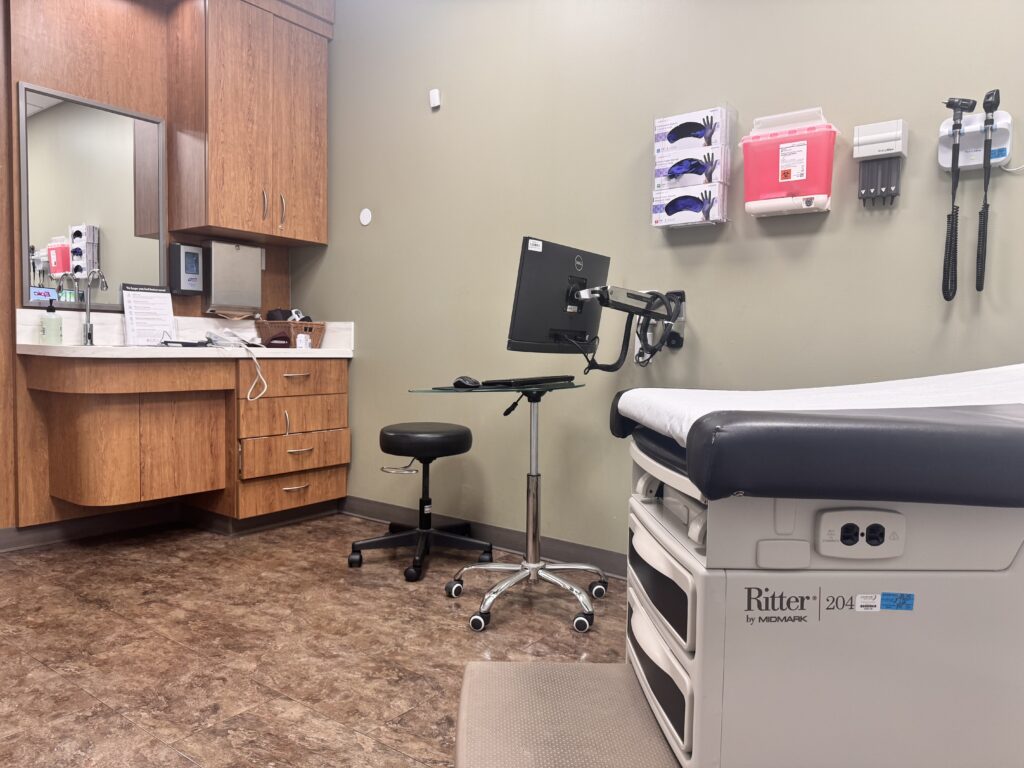
After she left the room and I waited for the test results, I noticed the boxes of blue surgical gloves hanging in a dispenser on the wall. They triggered a memory. We couldn’t enter Emery’s ICU room at St. Joseph’s without putting on a gown, a mask, and gloves first. The gloves were also the same ones the nurse had used as a hair tie when, for the first time, I didn’t have one on my wrist. She cut off the end and used it to pull Emery’s hair away from her face so it wouldn’t get tangled in the oxygen mask. I told her I was amazed at the skills nurses had, and she told me they have endless tricks up their sleeves.
I know my emotions were amplified, in part, because I wasn’t feeling well and because it was the 11-month anniversary. Actually, I was feeling bad enough that for a moment, I thought about the irony of my dying on the same date that Emery died, a year later. The death certificate would say pneumonia, but anyone reading it would know that it was really that big hole in my heart. I couldn’t live with it anymore. Morbid? Maybe. But that is what free-wheeling in grief looks like. There’s not much control.
I tested negative for COVID and influenza, but the chest X-ray was positive for pneumonia. I couldn’t help but think about how scared Emery must have been, given how scared I was, and then realized she wouldn’t have had the same framework I did. She didn’t know yet that people really do die from the flu, even healthy 34-year-olds.
In my clinician’s notes under Family History, it said:
Has a history of losing her 34-year-old daughter to the flu. Patient reports experiencing triggers and sad emotions while being here in the clinic.
Emery’s death is now a part of my medical history. Then again, of course it is.
I feel like I’m carrying a sleeping bag full of bricks and so desperately want to set it down. Even though it’s been 11 months, I still don’t feel like I’ve gotten any better at carrying a load I didn’t want to be handed in the first place. Today, a few more bricks were added. The pneumonia is not helping.
Last night, I lay in bed, on my back because that was the most comfortable position I could find, and I felt a heaviness, like someone had set a few of my bricks on my chest. The nurse had told me that it would likely happen, but I had forgotten. It brought me back to Emery, before intubated, but with the oxygen mask, texting that her chest hurt and the pain was a seven. I felt like I wasn’t just trying to understand what she had gone through, but as her mom, I was crawling into bed next to her to experience it for myself, and she was helping me; my three on pain, her seven. It made me long for that girl in the bed, whom I was unable to comfort, short of telling her how much I loved her and that the medicine would start to help. I had no idea. Last night, I briefly journeyed into her pain with my own pain. It did not give me comfort. Instead, it connected me deeper to her experience and the helplessness I felt.
It’s an impossible burden as a mother to know there was nothing I could do to help my daughter.