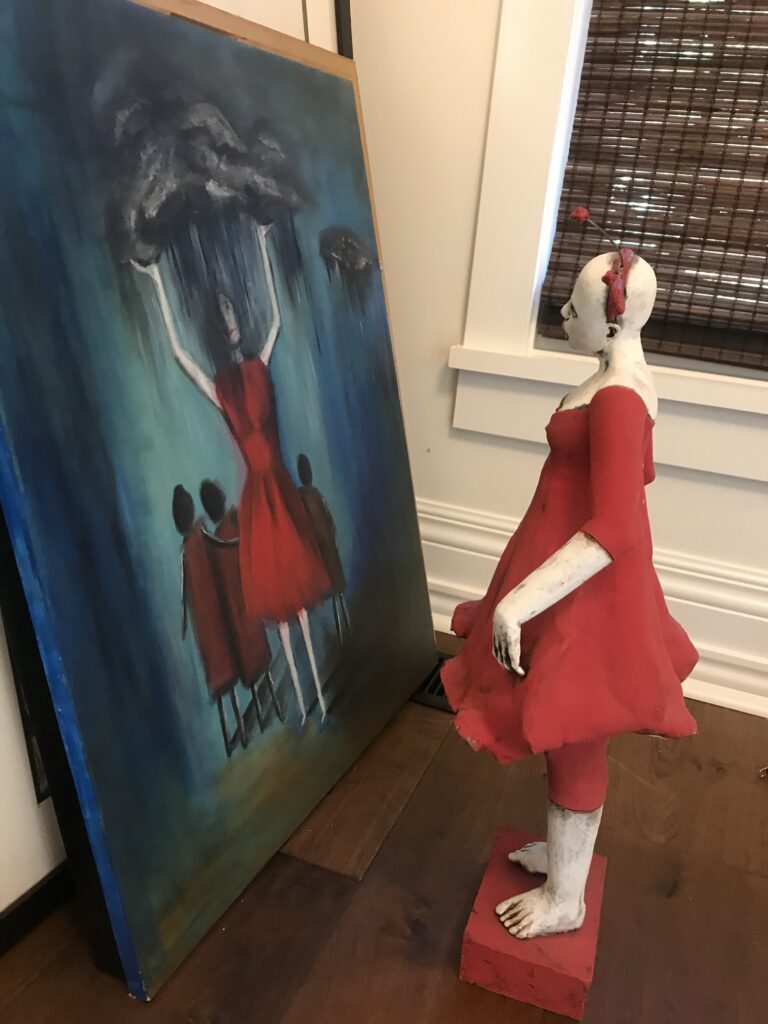
My red-dressed lady, curious about the red-dressed lady I painted. Soul sisters, united.
We were close to the door, and I had my credit card in my hand. Then Buzz, the plumber, set down his pen and invoice pad on an end table and told me he really liked my art collection and wanted to know more. Buzz was recommended to me, and this was his first time in my house. He had repaired my running toilet, but didn’t seem in any hurry to leave.
I thanked him, then asked if he’d prefer Venmo, a credit card, or a check if that were easier. He didn’t take the bait. Instead, he asked how long I had been collecting art and if I had spent time in Santa Fe.
I moved away from the door and back into the room. I was intrigued by his comment about my art collection. It was the second time someone had commented on my being an art collector, and the second time the comment struck me. I don’t know why, as I have collected art for the past 25 or so years, mostly from my travels, and am lucky to have the wall space in my house to showcase my collection. Still, I never thought of myself as a collector because it sounded too pretentious. I also collect books that line floor-to-ceiling shelves of a wall in my front room, which I’ve never called a library for the same reason.
I told Buzz that yes, I had been to Santa Fe many times, and we used to vacation there during spring break when my children were young, and they had all learned to ski there. I added that it was probably where my art-buying began. I should have left it at a yes, full stop, and focused on the task at hand… paying the bill. Instead, my comment opened the door to conversation. Buzz wasn’t picking up his invoice pad any time soon. He got comfortable.
He told me there was one particular painting he liked. It was in my living room, at the opposite end from where we were standing in my shotgun house. I was not going to get the fast exit I wanted. Instead, I followed Buzz to the back wall of my living room, where he stood in front of a large painting of a small house, with a big sky and storm clouds above it. I bought it shortly after moving to Boulder because it reminded me of my drives across western Kansas. He was looking at the painting as no one else had, except me, while in the gallery contemplating the purchase.
“This painting makes me happy. Beautiful art like this makes me happy. I mean, come on… that sky! You can almost feel the wind, can’t you?”
I looked at the painting, I mean, really looked at it, for the first time since I stood in front of it at the gallery. He was right. You could almost feel the wind.
I’ve had many people compliment me on the art in my house, but nothing like this. Next to the painting were four photographs I had taken in Peru and Nepal — close-ups of faces that intrigued me. He asked me where they were taken and why those people? One was of a young, Nepalese girl, her hands in a prayer, and the other three were elderly women from the center where I volunteered in Perú.
“It was the stories they weren’t telling. Their experiences, without words,” I told him.
He nodded and said he understood. He said photography was his first love, but plumbing paid the bills, so of course, he understood. When he was finished giving his opinions on the rest of the art in the room, we started walking back to where we started. I assumed we were wrapping things up, but he stopped in my kitchen and commented on two other photographs I had taken.
“You see things deeper than most people, or differently.”
I wasn’t sure what he meant. He explained.
“I can see that about you because, as a photographer, I don’t photograph what is present, but what isn’t. You do the same, both in the art you’ve chosen and in your photography. I had never heard that before. I went from wanting him to leave to thinking I should put the kettle on.
We returned to the front room, and he shared more stories about his photography and his art collection, which, due to space limitations, he had started selling. He told me about specific artists whose work he had purchased on Canyon Road in Santa Fe. Clearly, he was a serious collector. I was just someone who knew what she liked but couldn’t remember the artists’ names who graced my walls.
He took out his invoice pad and started writing again, then stopped, set it down again, and asked me about the small sculpture of the woman in the red dress that sat on a table in my front room. I’ve heard many strong opinions about my red-dressed woman, including from my realtor in Kansas City, who insisted I put it away before she showed my house to prospective buyers. She found it creepy. Emery also found it creepy, but her daughter, Muna, loved her. To each their own. He looked at her, without voicing his opinion (surprising), then looked into my nearby office and saw my painting of a woman in a red dress with three children. I told him I had taken several painting classes in the time leading up to my divorce and that I called that painting my divorce painting. The red-dressed sculpture was one I bought after my divorce. I shared her history with him.
“I saw the sculpture at Jazz Fest in New Orleans and made my way to the artist’s booth every one of the three days I was there to look at her. On my last day, I returned to the booth, picked up a smaller, less expensive figure of a girl in a white dress, and told the artist I wanted to purchase it. She was confused because it was the red-dressed girl whom I had become obsessed with. We went back and forth, and I finally told her the truth. The red-dressed girl was more than I wanted to pay, so I was compromising.The artist told me she wouldn’t sell me the white-dressed woman because it was not the one I wanted. She ended up reducing the price so I could buy the one I wanted. It still felt like too much, but given the lengths the artist was willing to go, I had to say yes. When I got home, I put her up on my mantle. The divorce painting was on the wall next to the fireplace. When I saw the two side by side, I knew why I had been so drawn to her. They were soul sisters, separated by space and medium. ”
Buzz liked the story and told me once again that art made him happy, and his saying that, while standing in front of my art, made me happy.
Fixing my toilets took less than an hour, but the art discussion that followed was almost as long, and I was glad for it. He handed me the bill, I gave him my credit card and he wrote down the numbers because he didn’t have a card reader, and then he was gone. The conversation about art, however, was not, and would continue the next day, albeit with his wife. She called me because my credit card had not gone through, and before saying anything else, told me Buzz really enjoyed my art while in my house. She also noted that her art-loving, photo-taking plumber husband is dyslexic and struggles to write numbers correctly, especially when he’s in the throes of an art discussion. She read the number he had written down over the phone, and I corrected her on the transposed digits.
After my Dad died last year, my cousin told me to look for sparkles every day. She told me again after Emery died, and this time, I was more mindful of her words. Sometimes the sparkle is so well disguised that you’re trying to rush it out of your house so you can get on with your life, until you realize that the detours and the pauses are life. A broken toilet and an artist and critic disguised as a plumber were my unexpected sparkle, which ran deeper than the relief of a functioning toilet.
Now, when I look at my painting of the small house and the big sky with storm clouds hanging over it, I recall what Buzz told me. “Art really makes me happy.”
It does me too, Buzz. I just forgot.