The teacher said something in Spanish that I didn’t understand.
“Muna, I didn’t understand what she said.” Muna nodded her head in agreement. “Oh, I didn’t either, Laudie.” “Well, should we find out?” I asked. “No, we’ll figure it out.” And we did, mostly by watching the other children. The language barrier I had anticipated with my grandchildren’s move to Costa Rica didn’t seem to be a barrier at all.
It was October, 2025, Muna’s birthday month, and I was in Costa Rica visiting because that is where Emery’s children now live with their dad, Miles. It’s been a difficult adjustment to make, from driving 10 minutes to their house to a day’s journey that requires my passport, but they are happy and have adjusted well, and that is all that matters to me. It is all that Emery would want. That, I know.
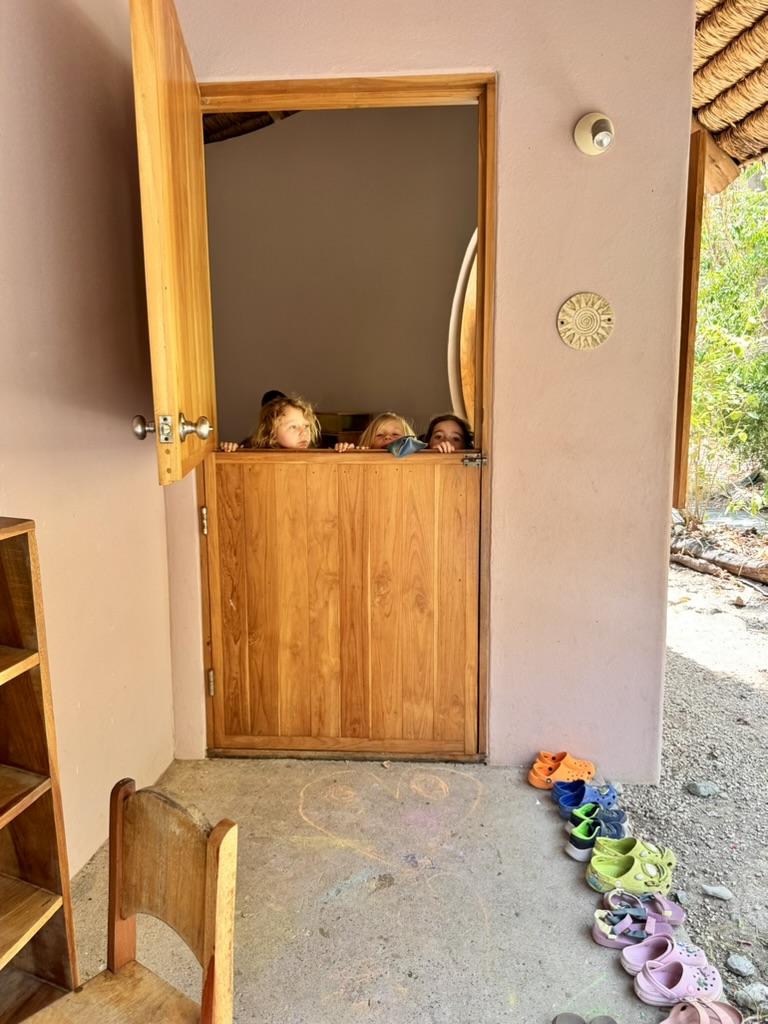
I spent the morning of Muna’s birthday in her kindergarten classroom with her and got to be a part of her birthday celebration with her classmates. Both of my grandchildren’s classes are conducted entirely in Spanish, but their teachers also speak English and will translate, but only if necessary. I worried about the Spanish. They didn’t. Muna told me she knew the word “butterfly” in Spanish. She felt confident. You’ve got to start somewhere.
Later that day, at Muna’s birthday party, one of her classmates arrived early, and they played in her room. She is from Argentina and doesn’t speak English, and after two months in Costa Rica, Muna didn’t speak Spanish, or didn’t talk Spanish, as she would say. The two were laughing and giggling in Muna’s room, with no shared language. It was beautiful to witness. The language was not a barrier for my grandchildren. Children laugh. They point. They smile. They share a language of expressions and actions I hadn’t considered. Six months later, I heard Muna speaking to the same friend in Spanish, and this time, when the teacher said something I didn’t understand, Muna translated for me. At one point, she corrected me on the verb I used with one of her friends. And she was right.
During my recent visit, I returned to Muna’s school to spend the day with her. As we were walking to her classroom, one of her classmates asked me if I was Muna’s mama. I caught Muna’s side-eyed glance at me, then told him no, I was her grandma. He nodded, but not quite satisfied with my answer, he asked, “Well, is her mama going to come?” Before I could answer, Muna jumped in and responded, “No, she’s not going to come because I don’t have a mama. She died.” He nodded and said, “Ok.” And that was that. It hurt my heart that she had to answer his question, but she did, and she did it with grace. The punctuations of grief are ever-present. The boy called me “Grandma” for the rest of the day, each time, with Muna correcting him with “Laudie,” but he preferred “Grandma.”
Muna has four children in her class who don’t have moms. The two girls whose moms died happen to be the two girls whom I saw Muna playing with the most. I watched them at recess playing house, arguing over who got to be the mom, the role that they all wanted. Situations like that, which normally wouldn’t faze me, do now. Whether I want to or not, I see with my grandchildren through the lens of two children whose mother died a little over a year ago. I’m grateful that Muna has other girls walking the same path as her, and whether or not they ever talk about their moms, there’s comfort in knowing she isn’t the only one.
While we were outside for recess, Muna’s teacher told me that Muna was a happy girl and had made many friends. Her words brought tears to my eyes. There are countless adults dealing with the grief of losing Emery, but the two children, who were five and seven at the time, have always been my greatest worry. I remember at the hospital shortly after Emery died, when it hit me that there were two family members who hadn’t yet heard. Arlo and Muna. What about Arlo and Muna? Mothers have an innate sense to protect their children from harm and become mama bears when that is challenged. The protection instinct extended to my grandchildren. Arlo and Muna…what about Arlo and Muna? Muna’s teacher told me something I hadn’t considered. My grandchildren’s circle of protection was far more expansive than I realized. It had traveled to another country.
I spent a lot of time volunteering in Emery’s kindergarten class, and watching Muna in her classroom felt like a step back in time for me. Like her Mama, Muna was a friend to all, especially to the ones who looked like they were being left out. At one point, while we were seated across from each other, she looked at me and asked me what was wrong. I told her nothing. She told me my face looked like something was wrong. Emery did the same throughout her life, asking me what was wrong, and I’d usually respond, “nothing,” then she’d raise her brows and ask again, and after a few rounds, I’d tell her, sometimes not even realizing it until she had pointed it out. She was always right. Muna was also right; something was wrong, but I couldn’t share it with her. I couldn’t tell her that what she was seeing on my face was the ache in my heart that Emery won’t be able to be the one to tell me that Muna asked the teacher a question in perfect Spanish, or that she is the best in the class at elastics jumping, a skill she only recently learned, or that her daughter is becoming more and more like her every day. I envisioned Emery, standing off to the side in the classroom, arms folded across her chest, and a big smile of pride on her face. And I’d look at her, and we’d share a moment as we did so often on the sidelines with Arlo and Muna. I’d give her a nod that would say, You did this, Emery. She is your darling girl. And she’d smile back at me and nod her head. So much pride. So much love. So much sadness. Muna was right. My heart showed up on my face, and I couldn’t deny it, although I did.
Arlo made coffee for me every morning, using the traditional Costa Rican pour-over method with a bolsita, or coffee sock, with apologies that he couldn’t make the milk into a heart as they do in coffee shops. It wasn’t steamed milk, poured out of a small spout, but rather, cold milk poured out of a bottle, but he tried. After the first morning, I told him I was also Ok with drinking the coffee black, because it was so good it didn’t need the milk. I sensed his relief at not having to try to make the hearts. The first thing I thought of, as with so many things, was texting Emery because she would have been so proud. She would have sent the laughing emoji, followed by, “I love that so much, Mom.”
I miss having them ten minutes away. I miss running over to jump on the trampoline with Arlo and Muna or having Emery drop them off here to play. I miss the spontaneity. A ten-minute drive is now an all-day journey, but every hour of that journey is worth it. Arlo and Muna are my heart and my promise to their Mama before she died. And they are my forever connection.