
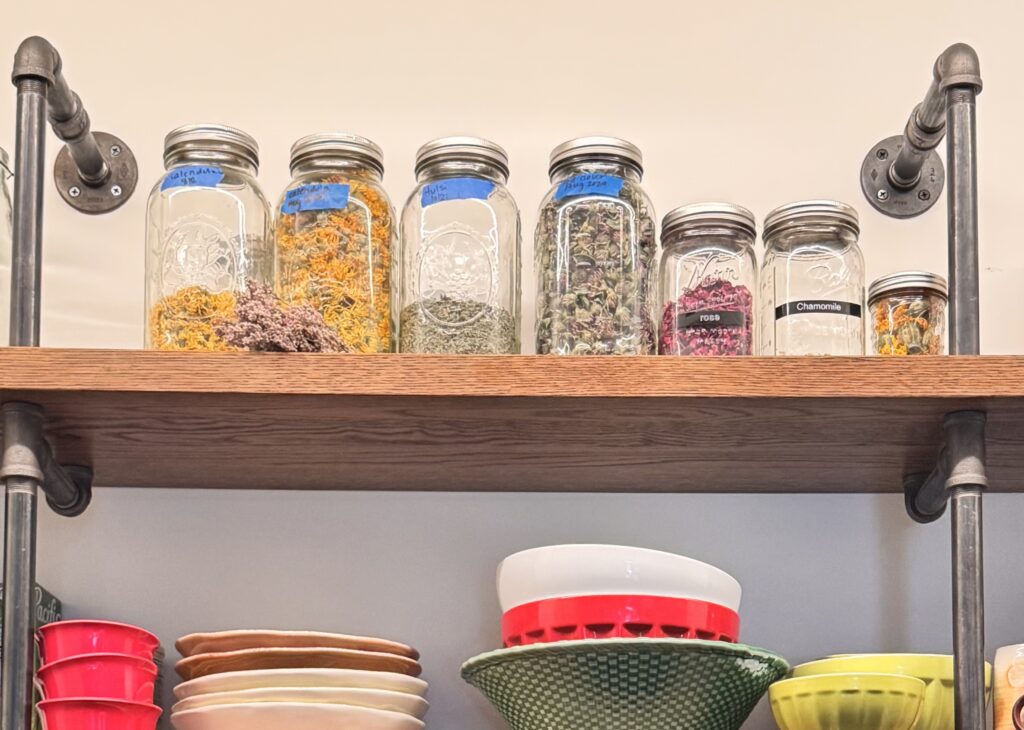
I have several large jars of herbs that Emery collected from her garden on my shelf, all marked with the contents and the date collected in her handwriting, using blue painter’s tape. The most recent one was collected in October 2024. The lineup of jars is beautiful in its variety of colors and textures, and although they are meant to be steeped in water and used in teas for healing or comfort, I will never make tea out of their contents. Instead, I look at the jars in their prominent position in my kitchen and often stop to open them and inhale their scents, but I don’t use their contents. I don’t want them to run out. They have become another way I’m honoring my daughter’s passions. Another way I am holding on. It feels like I’m inhaling a bit of Emery when I open the jars to take in their bouquet, provoking memories of walking through her gardens with her as she gathered herbs and flowers into a basket. Emery had a scent that she loved to wear, but her true scent didn’t come from a bottle. She smelled like the earth. Like lemon balm, anise, chamomile, and sweaty children. Emery smelled like life to me.
Jars of herbs, photos, stones, trinkets, and a river-rock paperweight painted like a ladybug she made in grade school, are among the many items that have become physical stand-ins for memories that are gathering organically in my home.
After Emery died, I helped two of her dearest friends clear her things out of the bathroom. I brought a box of her toiletries home—shampoos, lotions, moisturizers, perfume oils, and other bottles she dipped into on a daily basis. I used the products with care and love until I realized they would soon be gone, then added “sparingly” to my routine. Her bottles of product became tangible items when she wasn’t. What will happen when they become empty bottles? I can buy these products when hers run out, but will they hold the same value without the significance of having once been hers?
In my mind of magical thinking, I’m gathering pieces of her and bringing her back, one dried flower, one piece of rose quartz, one inhale of her herbs at a time. If I gather enough of her things, can I piece her back together again? Bring her back to me? Grief is the gateway to pondering the impossible and things you know will never happen, yet I keep doing it. I used to call Dad’s and Emery’s phones until they were no longer in service, knowing they wouldn’t answer, but what if, in my magical realm of thinking, they did?
Several months after Emery died, I had her daughter, Muna, over for a sleepover. She hadn’t spent the night by herself and was very excited, arriving with a backpack loaded with enough clothes and “had to bring it” items to last several nights. Miles told me she sometimes woke up in the middle of the night, crying out for her Mama, and that he would be sure to have his phone on just in case. I wasn’t sure what to expect, but I was ready. She headed up the steps to my room as if on a mission and said she would be “getting her things sorted out” and would be down in a minute. I went up to check on her a few minutes later, and she had taken all the miscellaneous bottles, headbands, combs, and her toothbrush from her toiletry bag and lined them up neatly on my bathroom counter. “Look, Laudie, it’s like I live here! With you!” She had settled in nicely. I looked at the items that came out of Emery’s pink satin toiletry bag that were organized on my bathroom counter—items of Emery’s that were given to her on the day of the bathroom clean—out: lipstick, eyeshadow, lotions, and creams. It reminded me of Emery when she was the same age, and I had taken her on a trip to visit one of my sisters. Toiletry items lined up in anticipation gave me comfort in their familiarity.
Later that night, Muna cried out, and I woke up, ready to comfort her, but she immediately fell back asleep. The light of the moon coming in through a window illuminated her face, and in my half-asleep state, I thought she was Emery. Her hair, her smell, and the way she held Sims, the stuffed dog that was once Emery’s, were Emery. It took me a moment to realize it was my granddaughter, not my daughter, lying next to me. I took in the beauty and innocence of the 5-year-old girl, who lay beside me, both of us suffering the unfathomable loss of a daughter and a mother. It hit me in that moment that the love Muna has for her Mama and the love I have for my daughter will always be intertwined in the love we share for each other. She will be my link to my daughter, and I will be her link to her Mama. The moment took my breath away. When she lay back down, it was like Emery had done as a child, with her head not on the pillow, but butted up next to it. I had stepped back in time for a moment, and five-year-old Emery and I were having a sleepover. Muna looks like Emery and shares her compassion, empathy, and strong will, and I often call her Emery out of habit. It will be the ache and the gift she will always carry.
The next morning, Muna put on a headband that I remembered Emery wearing. The pride with which she wore the much-too-big pink band, perched awkwardly at her hairline, made it even more beautiful. Emery’s things, spread out over three generations, both of us using and wearing them with deep love and pride, but for me, with the fear of them running out.
Last fall, I was in Kansas City with Thomas and Grant for the launch of the foundation they founded with Emery. I was wearing a pair of her shoes she had given me, which, after several wearings, she decided were too big. I wore them because they looked good with my outfit, but while I was being introduced throughout the evening as Emery, Thomas, and Grant’s Mom, I realized that wearing Emery’s shoes went far deeper than looking cute with the pants I had on. I was metaphorically and physically in her shoes, and I couldn’t help but smile with pride at the realization. At one point, I told one of the board members who was especially fond of Emery that I was wearing her shoes. She looked down at the clunky, black fisherman sandals, smiled and said, “I’m guessing there was a time when Emery would wear your shoes, as a little girl, and now it’s your time to wear hers. She’d be so proud of you.” And like Dorothy’s red shoes, the shoes I was wearing had a power I hadn’t expected.
When we were going through Emery’s things last summer, I noticed one of my Dad’s cards that he kept in his walker to give to people he met at his retirement home. They represented Dad so well that they were handed out at his celebration of life. It was propped up against a large piece of rose quartz on the nightstand next to Emery’s bed. I was touched to see the prominent place she had placed the card, knowing she read the words every night before sleep. The card said, Life isn’t about waiting for the storm to pass. It’s about learning to dance in the rain. We’re all trying to find out dance steps in the rain without falling, Dad.
The purse that Emery “borrowed” a dozen or so years ago is back in my possession, and it made me happy that she had a few of Dad’s cards in it, along with a Photo Booth photo of Muna and me and a few parking tickets. It was the purse she had carried up until a few days before she died, and after seeing it for so many years on her shoulder, it feels good to be back on mine. Pieces of Emery. On my shoulder, on my wrists, on my face, on my body. The tangibles when she is no longer.
A few days after Emery died, I noticed that Muna was wearing one of Emery’s hair clips in her hair. The oversized clip in her fine curls, a combination of vulnerability and love, had me holding back tears. At one point, she took it out and asked me to hold onto it for her. I told her I would, then before she left the room, she came back to me and in a very quiet, secret-like voice, said, “Be very careful with it, Laudie; it was Mama’s, and I don’t want anything to happen to it.”
I took the clip from her, receiving it from her small hand to mine, like a delicate flower. I held it for a while, then, rather than setting it down, I put it in my hair, checking first for loose hairs, almost instinctually. I wondered when it was last in Emery’s hair.
I’m holding onto the relics of memory I can touch, wear on my body, or take in through their scent, and am comforted in their familiarity. Pieces of Emery.